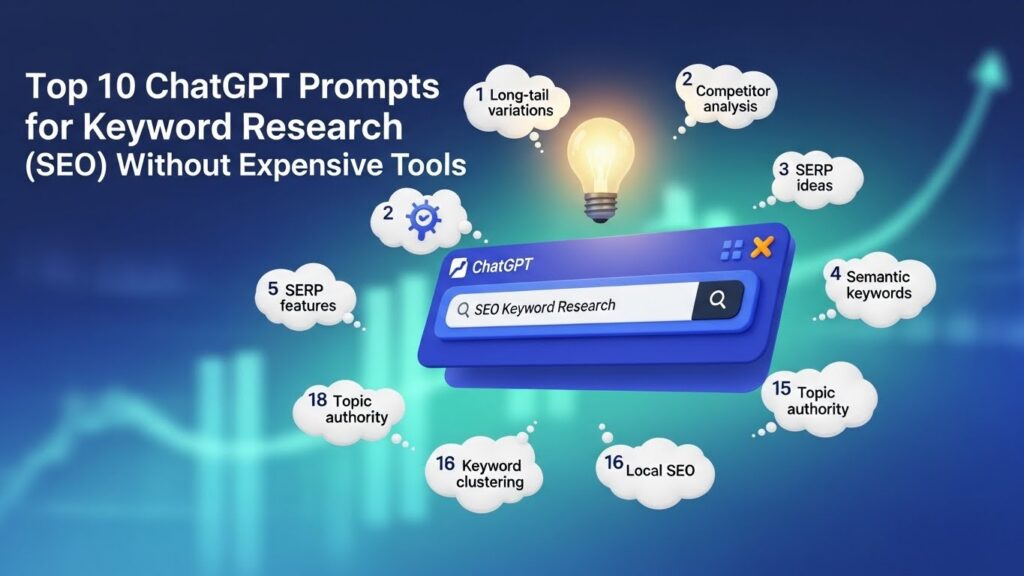
Top 10 ChatGPT Prompts for Keyword Research (SEO) Without Expensive Tools
Let’s talk about that sinking feeling when you realize SEO success requires keyword research tools that cost $99, $199, or even $399 per month. You’re a solopreneur, blogger, or small business owner who can’t justify spending thousands annually on Ahrefs or SEMrush. So you’re stuck using free tools with 3 searches per day limits, outdated data, and keyword suggestions so generic they’re useless. Meanwhile, your competitors with bigger budgets are dominating search results because they know exactly what people are searching for.
Here’s the uncomfortable truth: expensive keyword research tools are powerful, but most users only scratch the surface of what they pay for. The real value isn’t the tool itself, it’s understanding search intent, identifying content gaps, analyzing competition, and thinking strategically about keyword opportunities. These are cognitive skills, not software features. You’re not failing because you lack expensive tools. You’re struggling because you haven’t learned to think like an SEO strategist.
What if you could conduct professional-quality keyword research using free resources and strategic thinking? What if ChatGPT could help you identify high-opportunity keywords, analyze search intent, understand topic clusters, and develop content strategies that compete with sites using premium tools? That’s exactly what these 10 ChatGPT prompts will help you achieve: strategic SEO keyword research that relies on intelligence and methodology rather than expensive subscriptions.
Why Most Keyword Research Fails (Even With Expensive Tools)
Before diving into the prompts, let’s understand why keyword research often produces poor results:
Volume obsession ignores intent. Chasing high-volume keywords without understanding what searchers actually want leads to content that ranks poorly or attracts the wrong traffic. A keyword with 50,000 monthly searches but mismatched intent is worthless.
Competition is misunderstood. Most people see high competition and give up, or target “easy” keywords that aren’t worth ranking for. Understanding competitive dynamics requires nuance that raw difficulty scores don’t capture.
Long-tail keywords get ignored. Everyone wants to rank for “running shoes” (impossible for new sites) while ignoring “best running shoes for flat feet and knee pain” (achievable and valuable). Long-tail represents the majority of searches but gets minority of attention.
Search intent is assumed, not researched. You think you know why people search for a keyword, but Google’s actual results reveal what it believes the intent is. Mismatched content doesn’t rank, regardless of optimization.
Topic clusters are neglected. Ranking for isolated keywords is harder than building topical authority through comprehensive content clusters. Most keyword research produces random keyword lists instead of strategic topic maps.
Searcher journey is ignored. Keywords represent different stages: awareness, consideration, decision. Content optimized for one stage but targeting another stage’s keywords fails to convert.
Keyword cannibalization goes unnoticed. Multiple pages targeting similar keywords compete with each other, diluting ranking potential. Without strategic planning, you’re competing against yourself.
ChatGPT can’t replace data tools completely, but it can provide the strategic thinking, intent analysis, and content planning that turn raw keywords into ranking opportunities.
How to Use These Prompts for Strategic SEO Success
Getting maximum value from these prompts requires combining ChatGPT’s intelligence with free verification:
Use Google itself for data. Google Search, Google Suggest, People Also Ask, and Related Searches provide real keyword data at zero cost. ChatGPT helps you interpret and expand this data.
Verify with free tools. Google Keyword Planner (requires Google Ads account but free), Google Trends, and AnswerThePublic provide volume estimates and trend data. Use these to validate ChatGPT’s suggestions.
Think topics, not just keywords. SEO success comes from comprehensive topic coverage, not ranking for one keyword. Use ChatGPT to map entire content strategies.
Prioritize intent over volume. A keyword with 500 searches but perfect intent match beats a keyword with 50,000 searches but mismatched intent.
Combine multiple prompts. Use one prompt for keyword generation, another for intent analysis, a third for content planning. Layer insights for comprehensive strategy.
Document everything. Keep a keyword research database tracking opportunities, intent, competition, and content plans. Strategic accumulation builds advantage over time.
Now let’s explore the prompts, organized by keyword research phase and strategic objective.
Keyword Discovery and Generation Prompts
1. The Seed Keyword Expansion Engine
I want to expand keyword opportunities around my core topic: [your main topic/niche]. Generate comprehensive keyword variations using these strategies: (1) Semantic variations and synonyms that searchers might use instead. (2) Question-based keywords (how, what, why, when, where, which, who). (3) Comparison keywords (vs, versus, or, alternative to). (4) Problem-solution keywords (how to fix, solve, prevent, avoid). (5) Modifiers that indicate search intent (best, top, review, guide, tutorial, cheap, professional). (6) Long-tail combinations that address specific needs. For each category, provide 10-15 examples. Organize these by likely search intent (informational, commercial, transactional, navigational). I want to see the strategic thinking, not just a keyword list.
Why this works: Strategic expansion from seed keywords reveals opportunities competitors miss. This prompt applies systematic thinking to uncover keyword variations across intent types and searcher needs.
2. The Competitor Keyword Reverse Engineering
My main competitors ranking for my target topics are: [list 2-3 competitor URLs or domains]. I can't access their keyword data, but help me reverse-engineer their strategy: (1) Analyze their site structure and main content categories. What topics are they covering comprehensively? (2) Based on their content, what keywords are they likely targeting? (3) What content gaps exist, topics they should cover but don't? (4) What subtopics within my niche get detailed coverage versus shallow treatment? (5) How are they clustering content around pillar pages versus supporting content? (6) What keyword modifiers appear frequently in their titles and headers? Help me understand their SEO strategy through observable content patterns, then identify opportunities they're missing.
Why this works: Competitor analysis reveals proven keyword opportunities and strategic gaps. This prompt extracts insights from publicly visible content patterns without needing access to their keyword data.
3. The Search Intent Deep Dive Analyzer
For the keyword [specific keyword], help me understand search intent comprehensively: (1) What does Google currently rank for this keyword? Describe the top 10 results' content types (blog posts, product pages, videos, tools, etc.). (2) What does this ranking pattern reveal about what Google believes the search intent is? (3) Are there mixed intents (informational + commercial) or is it clearly one intent? (4) What questions are People Also Ask showing for this keyword? (5) What does this tell me about what content I need to create to rank? (6) If my content doesn't match Google's determined intent, what adjacent keywords with different intent should I target instead? Prevent me from creating content that won't rank because it mismatches intent.
Why this works: Intent matching is critical for ranking. This prompt teaches you to read Google’s signals about what content belongs on page one, preventing wasted effort on mismatched content.
Strategic Keyword Analysis Prompts
4. The Keyword Difficulty Reality Check
I'm evaluating whether to target [keyword]. I don't have paid tools for difficulty scores. Help me assess competition manually: (1) What factors make a keyword difficult to rank for beyond just "high competition"? (2) Based on what I can observe, the top results are [describe: all major brands, mix of brands and small sites, mostly small sites/blogs]. What does this tell me about rankability? (3) Domain authority alternatives: can I assess site strength by looking at backlink mentions, social shares, content depth? (4) What content quality standards must I meet or exceed to compete? (5) Realistically, as a [small site/new site/established but small site], should I target this keyword or find alternatives? (6) If too competitive, what adjacent long-tail variations might be achievable? Give me honest assessment, not false hope.
Why this works: Keyword difficulty isn’t just a number in a tool. This prompt teaches manual competition assessment using observable factors, providing realistic evaluation of ranking potential.
5. The Long-Tail Opportunity Identifier
My main keyword is [broad keyword] but it's too competitive. Generate strategic long-tail variations that: (1) Address specific problems, use cases, or demographics within this topic. (2) Include location modifiers if relevant to my business. (3) Incorporate technology, tools, or methods (how to do X with Y). (4) Target specific scenarios, situations, or contexts. (5) Combine my keyword with buyer intent signals. (6) Address objections or concerns (X without Y, X that doesn't Y). For each long-tail suggestion, estimate likely competition level (low/medium/high) based on specificity and explain why someone would search this exact phrase. I want keywords real humans actually search, not just grammatically awkward long phrases.
Why this works: Long-tail keywords are more achievable and often convert better. This prompt generates natural long-tail variations that match real search behavior rather than artificial keyword stuffing.
6. The Content Gap and Opportunity Mapper
My niche is [specific niche]. Help me identify content gaps and keyword opportunities that competitors are missing: (1) What subtopics within this niche deserve comprehensive content but probably lack it? (2) What specific questions do beginners versus advanced users have that might not have good answers? (3) What pain points, objections, or concerns do people have that deserve dedicated content? (4) What comparison content is missing (X vs Y comparisons)? (5) What how-to content addresses specific scenarios rather than generic tutorials? (6) What update or news angles create timely content opportunities? Map these opportunities to potential keyword targets and explain why these gaps exist (hard to monetize, time-intensive to create, requires expertise, etc.).
Why this works: Content gaps represent low-competition opportunities where quality content can rank easily. This prompt identifies strategic opportunities based on market needs rather than just search volume.
Topic Clustering and Content Strategy Prompts
7. The Pillar Content and Cluster Strategy Builder
I want to build topical authority around [main topic]. Design a pillar-cluster content strategy: (1) Identify the main pillar topic that deserves a comprehensive, authoritative guide. What should this cover? (2) Generate 10-15 cluster topics that support this pillar. Each should address a specific subtopic in detail. (3) For each cluster topic, suggest 3-5 supporting keywords or questions. (4) Explain the internal linking strategy: how should clusters link to the pillar and to each other? (5) Identify content creation priority: which pieces to create first to build momentum? (6) How does this cluster establish topical authority that helps all pieces rank better? Give me a complete content roadmap, not just a keyword list.
Why this works: Topical authority through content clusters ranks better than isolated keyword targeting. This prompt creates a strategic content ecosystem that signals expertise to Google.
8. The Semantic Keyword and LSI Term Generator
For my target keyword [main keyword], generate semantic and LSI (Latent Semantic Indexing) keywords that should appear naturally in comprehensive content: (1) Related concepts and terms that Google expects to see in quality content about this topic. (2) Co-occurring keywords that frequently appear alongside the main keyword in top-ranking content. (3) Supporting terminology that demonstrates topical expertise. (4) Entity mentions (people, places, tools, concepts) relevant to this topic. (5) How to naturally incorporate these terms without keyword stuffing or forced inclusion. (6) Which semantic keywords matter most versus which are optional? Help me create comprehensive content that signals topical relevance through natural semantic richness.
Why this works: Modern SEO requires semantic richness, not just exact keyword matching. This prompt ensures your content demonstrates comprehensive topic coverage that Google recognizes.
Local and Niche-Specific Prompts
9. The Local SEO Keyword Strategy
I'm targeting local search for [business type] in [location]. Develop a local keyword strategy: (1) Geographic modifiers to combine with my service keywords (neighborhood names, landmark-based, "near me" variations). (2) Local intent keywords (best X in [city], [city] X services, X [zip code]). (3) Question keywords with local intent (where to find X in [city], who does X in [area]). (4) Service-specific local combinations. (5) Comparison keywords for local competitors. (6) How to research which geographic modifiers actually get searched versus which are too granular? (7) Content strategy: location pages, service area pages, neighborhood guides. Create a local SEO keyword framework that matches how local customers actually search, accounting for the fact that some locations get more search volume than others.
Why this works: Local SEO has unique keyword patterns around geography and proximity. This prompt develops location-specific keyword strategies that match local search behavior.
10. The Niche Authority Keyword Roadmap
I'm building authority in the specific niche of [detailed niche description]. Create a comprehensive keyword roadmap: (1) Foundation keywords every site in this niche must rank for to be taken seriously. (2) Authority-building keywords that demonstrate deep expertise. (3) Emerging topics or trends in this niche that represent early opportunities. (4) Problem-solving keywords that address specific pain points. (5) Comparison and alternative keywords for people evaluating options. (6) Advanced/expert-level keywords that competitors neglect because they target beginners. (7) Community-specific terminology or jargon that signals insider knowledge. Organize this into a 6-12 month content calendar prioritizing foundation first, then authority-building, then advanced topics. Show me how to systematically build niche dominance through strategic keyword targeting.
Why this works: Niche authority requires systematic coverage from basics to advanced topics. This prompt creates a strategic roadmap that builds credibility progressively rather than randomly publishing content.
Advanced SEO Strategy and Free Tool Usage
Beyond prompts, understanding how to validate and enhance ChatGPT’s suggestions creates complete strategies:
Free Tools to Validate ChatGPT Keyword Ideas
Google Keyword Planner. Requires a Google Ads account (free to create, no spending required). Provides search volume ranges and competition levels for Google Ads (not always identical to organic competition but useful indicator).
Google Trends. Shows search interest over time, geographic distribution, and related queries. Perfect for identifying trending topics, seasonal patterns, and rising keywords.
Google Search Console. If you have an existing site, GSC shows which keywords already drive impressions and clicks. This reveals opportunities to optimize existing content or create new content for related keywords.
AnswerThePublic. Free tier provides question-based keywords and prepositions. Great for understanding what people ask about your topic.
Google Autocomplete and Related Searches. Type your keyword and see what Google suggests. Scroll to the bottom of results for related searches. This is Google telling you what people actually search for.
People Also Ask boxes. Each question expands to show more questions. This reveals the information ecosystem around a keyword and common user questions.
Reading Google’s Ranking Signals
SERP analysis teaches intent. If Google ranks mostly product pages, it’s transactional. Mostly guides and articles means informational. Mix indicates hybrid intent.
Featured snippets reveal opportunities. If a featured snippet exists, you can target that format. If none exists but the keyword seems suitable, there’s an opportunity to optimize for snippet capture.
Top-ranking content length matters. If top results are all 3000+ words, your 500-word post won’t compete. Match or exceed the depth Google’s algorithm rewards for that keyword.
Result diversity signals competition. If page one shows mostly big brands, it’s competitive. If smaller sites rank, there’s opportunity.
Search Intent Classification Framework
Informational intent. User wants to learn something. Keywords include: how to, what is, why does, guide to, tutorial. Content type: blog posts, guides, tutorials, videos.
Commercial investigation. User researching before purchase. Keywords include: best, top, review, comparison, vs, alternative. Content type: comparison posts, reviews, roundups, buying guides.
Transactional intent. User ready to take action. Keywords include: buy, price, discount, order, deal, coupon. Content type: product pages, service pages, signup pages.
Navigational intent. User looking for specific site or page. Keywords include brand names, product names, login. Content type: homepage, brand pages, specific tools.
Understanding intent prevents wasted effort. Creating informational content for transactional keywords (or vice versa) results in poor rankings because Google recognizes the mismatch.
Building Topical Authority Without Tools
Comprehensive topic coverage signals expertise. Cover a topic from beginner to advanced, addressing all common questions and scenarios. This depth signals authority more than any single keyword optimization.
Internal linking creates topic relationships. Link related content together. This helps Google understand your site’s topical organization and strengthens rankings for all interlinked pages.
Content freshness maintains relevance. Regularly updating content signals active expertise. Add new information, update statistics, refresh examples.
E-E-A-T principles apply. Experience, Expertise, Authoritativeness, Trustworthiness aren’t just about credentials. They’re demonstrated through content quality, comprehensiveness, citations, and update frequency.
Your Strategic SEO Research Starts Now
You now have 10 powerful ChatGPT prompts that transform keyword research from expensive-tool-dependent to strategic-thinking-driven. These prompts don’t replace data tools entirely, but they provide the intelligence, analysis, and strategy that tools can’t deliver.
The difference between SEO professionals who succeed with premium tools and those who waste them isn’t the tool itself. It’s strategic thinking about search intent, content gaps, topical authority, and user needs. These prompts develop that strategic capability regardless of your budget.
Here’s your action plan starting today: Stop using “I can’t afford Ahrefs” as an excuse for not doing SEO. Stop randomly creating content without keyword research. Stop chasing high-volume keywords without understanding competition or intent.
Instead, define your core topic or niche clearly. Use the Seed Keyword Expansion Engine prompt to generate comprehensive keyword variations across intent types.
Then validate these keywords using free tools. Check Google Autocomplete for each variation. Look at People Also Ask boxes. Use Google Trends to verify interest over time.
Open ChatGPT right now. Spend 30 minutes with one prompt that addresses your immediate need. Maybe it’s the Search Intent Deep Dive to understand what content to create. Or the Content Gap Mapper to find opportunities competitors miss.
Provide specific details about your niche, target audience, and business goals. Get strategic recommendations, not just keyword lists.
Then take action on the insights. Create one piece of content optimized for a well-researched, intent-matched keyword. Track its performance in Google Search Console over 30-90 days.
Build a keyword research database. Document every keyword you evaluate: target keyword, search intent, competition assessment, content angle, priority level. This accumulating knowledge becomes your strategic asset.
The version of yourself with consistent organic traffic, rankings that drive actual business results, and content that serves real user needs isn’t built through expensive tool subscriptions.
It’s built through strategic thinking, intent understanding, systematic topic coverage, and creating content that genuinely deserves to rank, all of which these prompts enable.
Your SEO success doesn’t require a $399/month tool budget. It requires strategic intelligence about search behavior, competitive analysis, and content planning.
Your organic traffic growth is one strategic keyword away. Stop making excuses. Start thinking strategically.
What keyword are you researching first?
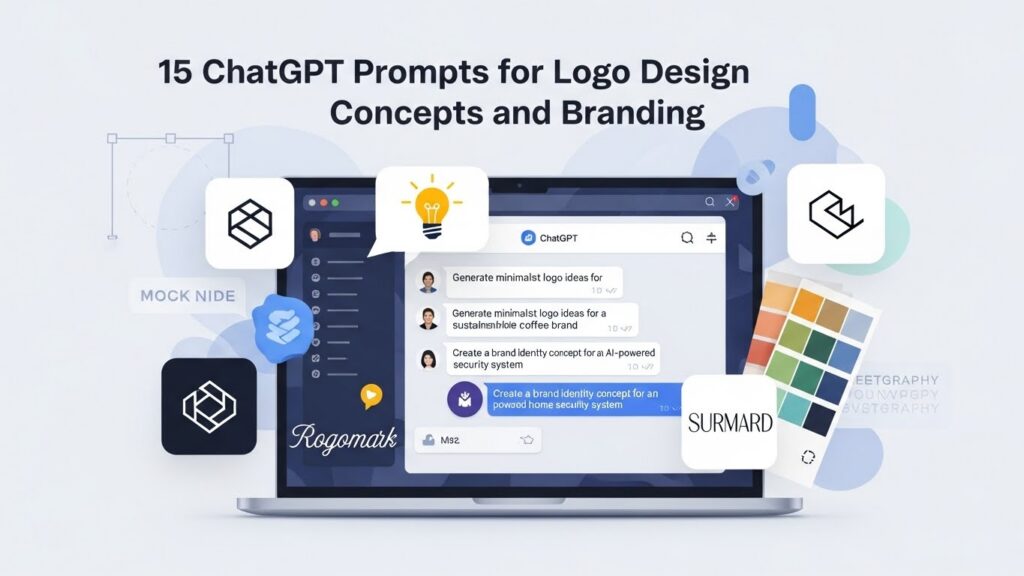
![# 15 ChatGPT Prompts for Logo Design Concepts and Branding Let's talk about the moment you realize you need a logo for your business. You open a blank Canva page, stare at it for twenty minutes, try combining your initials with a random shape, and end up with something that looks like a toddler's arts and crafts project. Meanwhile, professional designers charge $5,000+ for logo packages, freelancers on Fiverr deliver generic clipart with your name slapped on it, and you're stuck between unaffordable quality and affordable garbage. Here's the brutal reality: most small business logos are forgettable at best, actively harmful at worst. Not because founders lack taste, but because they lack the strategic thinking that transforms a pretty picture into a brand identity that communicates value, builds recognition, and differentiates from competitors. A logo isn't decoration—it's visual shorthand for everything your business represents. Getting it wrong means every marketing dollar works harder to overcome that first impression. What if you could access professional branding strategy and design direction without the professional price tag? What if you could develop logo concepts that are strategically sound, visually distinctive, and authentically represent your business? That's exactly what these 15 ChatGPT prompts will help you achieve—strategic brand development and logo design concepts that you can either execute yourself or hand to a designer with clear direction, saving thousands while getting better results. ## Why Most DIY Logos Fail Spectacularly Before diving into the prompts, let's understand why logo design is harder than it looks: **Pretty doesn't equal effective.** A logo can be aesthetically pleasing but strategically wrong—communicating the wrong message, targeting the wrong audience, or looking dated before it launches. **Trends age terribly.** That gradient everyone's using this year? It'll look embarrassingly dated in three years. Chasing trends guarantees your logo has an expiration date. **Complexity kills recognition.** Intricate designs with seven colors, three fonts, and elaborate illustrations might look impressive up close but become illegible at small sizes or in black and white. **Generic symbols communicate nothing.** The lightbulb for "ideas," globe for "global," or handshake for "partnership"—these overused metaphors make you invisible, not memorable. **No strategic foundation.** Most people design logos without first defining brand positioning, target audience, competitive differentiation, or desired perception. You're decorating before building the foundation. **Wrong medium assumptions.** Your logo needs to work on business cards, billboards, social media avatars, embroidered shirts, and black-and-white faxes (yes, some industries still fax). Designing only for one context creates problems everywhere else. **Amateur execution of good concepts.** You might have a brilliant concept but lack the design skills to execute it professionally. Kerning, color theory, proportion, balance—these technical elements separate amateur from professional. ChatGPT can't design the final logo for you, but it can provide the strategic foundation, conceptual direction, and design brief that ensures whatever you create—or commission—is strategically sound and professionally viable. ## How to Use These Prompts for Strategic Branding Getting maximum value from these prompts requires doing the strategic work before the visual work: **Complete brand strategy first.** Who are you? What do you do? Who is it for? Why does it matter? What makes you different? These answers drive design decisions. **Be honest about your constraints.** Budget, timeline, design skills, and production needs (print, embroidery, etc.) all affect what's realistic. **Think beyond the logo.** Your logo is one element of a brand system. Consider how it works with colors, typography, imagery, and tone across all touchpoints. **Avoid aesthetic preferences without strategy.** "I like blue" is irrelevant. "Blue communicates trust and reliability, which aligns with our financial services positioning" is strategic. **Prepare for iteration.** First concepts are rarely final. Plan for refinement based on testing, feedback, and living with ideas before committing. **Know when to hire professionals.** ChatGPT provides strategy and concepts, but complex execution often requires design expertise. Use prompts to create a clear brief for professionals. Now let's explore the prompts, organized by branding and design phase. --- ## Brand Strategy Foundation Prompts ### 1. The Brand Positioning Blueprint ``` I'm developing a brand for [business name/description]. Help me establish strategic positioning before designing anything visual. Walk me through: (1) Defining our target audience—who specifically are we serving? Demographics, psychographics, pain points, aspirations. (2) Our core value proposition—what transformation or outcome do we deliver? (3) Competitive differentiation—what makes us genuinely different from alternatives? (4) Desired brand perception—how do we want to be perceived? What feelings should our brand evoke? (5) Brand personality—if our brand were a person, how would they behave, speak, dress? (6) Non-negotiable brand attributes—what must our visual identity communicate? Make this specific and strategic, not vague marketing speak. This positioning drives every design decision. ``` **Why this works:** Design without strategy is decoration. This prompt establishes the foundation that makes logos meaningful rather than arbitrary. ### 2. The Competitive Brand Audit ``` Analyze competitor branding in [industry/niche]: [list 3-5 main competitors]. For each, describe: their visual identity (colors, style, symbolism), what their branding communicates, who they're targeting, and what makes them distinctive or generic. Then identify: (1) Visual patterns everyone uses—clichés to avoid. (2) Gaps in positioning—what's no one communicating that we could own? (3) Opportunities for differentiation—how can our visual identity stand out while remaining appropriate for the industry? (4) What must we signal to be taken seriously, versus where we can break conventions? I need to understand the visual landscape before designing, so I differentiate instead of blending in. ``` **Why this works:** Understanding the competitive landscape prevents creating a me-too logo that disappears among similar competitors while identifying white space you can own. ### 3. The Brand Archetype and Personality Definer ``` Help me define our brand personality using archetypal frameworks. Our business: [describe what you do and for whom]. Analyze which brand archetype(s) fit best: Creator, Sage, Explorer, Outlaw, Magician, Hero, Lover, Jester, Everyman, Caregiver, Ruler, or Innocent. For our top 2-3 archetypes, explain: (1) How this archetype manifests visually—typical colors, shapes, styles, symbolism. (2) What this archetype communicates to audiences. (3) How to differentiate within this archetype—everyone can't be the "innovative disruptor." (4) Potential visual directions that authentically express this personality. Then create 3-5 mood words that should guide all design decisions. This personality should feel authentic to who we actually are, not aspirational fiction. ``` **Why this works:** Brand archetypes provide proven frameworks for consistent personality expression. They help translate abstract personality traits into concrete visual direction. --- ## Logo Concept Development Prompts ### 4. The Strategic Logo Brief Creator ``` Create a comprehensive logo design brief for: [business name and detailed description]. Include: (1) Company overview—what we do, target audience, positioning. (2) Logo objectives—what must this logo accomplish? (3) Design requirements—where will it be used? Size range? Color vs. black and white? (4) Competitive context—how must we look similar enough to be credible but different enough to stand out? (5) Mandatory elements vs. nice-to-haves. (6) Absolutely avoid—what would be wrong for this brand? (7) Success criteria—how will we know if this logo works? Make this brief so clear that a designer could work from it without further input. This is my roadmap, whether I design myself or hire someone. ``` **Why this works:** A clear brief prevents endless revision cycles and ensures design aligns with strategy. Even DIY designers benefit from structured direction. ### 5. The Logo Concept Direction Generator ``` Based on this brand strategy: [summarize your positioning, audience, differentiation], generate 5 distinct logo concept directions. For each direction, describe: (1) Core visual approach—wordmark, lettermark, abstract symbol, pictorial mark, or combination? (2) Conceptual foundation—what idea or meaning does this approach communicate? (3) Stylistic characteristics—geometric or organic? Modern or classic? Minimal or detailed? (4) Color direction—what palette supports this concept? (5) Why this approach fits our brand strategy. (6) Potential challenges or considerations. Make these genuinely different approaches, not variations on the same idea. I want to explore diverse directions before committing to one. ``` **Why this works:** Exploring multiple distinct concepts prevents fixating on one direction too early. Variety reveals which strategic approach resonates most authentically. ### 6. The Visual Metaphor and Symbolism Explorer ``` I want to explore meaningful visual metaphors for [business type and positioning]. Don't give me generic industry symbols—help me find fresh, unexpected connections. Brainstorm: (1) Direct symbolism—what literally represents what we do? (2) Conceptual metaphors—what abstract concepts (growth, connection, transformation, protection) relate to our value proposition? (3) Hidden meanings—visual elements with dual interpretations or layered significance. (4) Geometric or abstract representations—shapes that communicate feeling without literal imagery. (5) Negative space opportunities—what can we communicate through what's NOT there? For each idea, explain the symbolic connection and whether it's overused or fresh. Push me beyond obvious choices toward memorable distinction. ``` **Why this works:** Meaningful symbolism creates logos with depth and storytelling potential. This prompt moves beyond cliché toward symbols that authentically represent your unique brand. --- ## Typography and Wordmark Prompts ### 7. The Typography Psychology and Selection Guide ``` I'm developing a logo for [brand with positioning]. Help me understand typography strategy: (1) What does typography communicate psychologically? Serif vs. sans-serif, geometric vs. humanist, condensed vs. extended, light vs. bold. (2) What typographic style aligns with our brand personality [specify personality]? (3) Generate 3-5 specific typography direction options ranging from conservative to bold, explaining what each communicates and who it appeals to. (4) How should our typography relate to competitors—similar enough for credibility, different enough for distinction? (5) Technical considerations—must work at small sizes, readable at a glance, works in various weights. Guide me to typography that supports strategy, not just aesthetics. ``` **Why this works:** Typography is half the logo (or all of it for wordmarks). Understanding psychological impact of type choices prevents arbitrary decisions that undermine positioning. ### 8. The Custom Letterform Design Direction ``` I want to create a distinctive wordmark or lettermark for [brand name]. The name is: [provide name]. Our brand positioning: [summarize strategy and personality]. Help me explore letterform modifications that add distinctiveness: (1) Which letter(s) offer the most opportunity for unique treatment? (2) What modifications align with our brand—geometric precision, organic curves, sharp angles, playful connections? (3) How can letters interact—overlapping, connected, separated with intent? (4) Negative space opportunities within letterforms? (5) Should any letters serve double duty or incorporate subtle symbolism? Provide 3-5 specific direction ideas for customizing our wordmark that feel intentional and strategic, not arbitrary or gimmicky. ``` **Why this works:** Custom letterforms create ownable brand assets. This prompt identifies strategic opportunities for distinction through typography modification rather than random flourishes. --- ## Color Strategy and Psychology Prompts ### 9. The Strategic Color Psychology Deep Dive ``` Develop a strategic color palette for [brand with positioning and audience]. Don't just tell me "blue is trustworthy"—I need nuanced analysis: (1) What specific emotions and associations does our brand need to evoke based on our positioning? (2) Which color families support these goals? Consider both expected choices and unexpected alternatives. (3) How does our audience's cultural context affect color perception? (4) What are competitors using, and should we align or differentiate? (5) Generate 3 distinct color direction options with 2-3 colors each, explaining the psychological strategy behind each palette. (6) How will these colors work across contexts—digital, print, products, environments? Consider accessibility, reproduction costs, and versatility. ``` **Why this works:** Color carries psychological weight that can reinforce or undermine your positioning. Strategic color selection enhances communication rather than just looking pretty. ### 10. The Color Differentiation Strategy ``` Everyone in [industry/niche] uses [common color like blue, green]. Our brand: [positioning]. Help me decide: Should we (A) Use the expected color but differentiate through specific shade and combination? (B) Break category conventions with unexpected color that stands out? (C) Use color strategically across brand system but keep logo neutral? For each option, explain: pros/cons, what it communicates, risk/reward, when it makes sense. Then recommend 3 specific color approaches with strategic rationale. I need to make an informed choice about conforming versus defying category norms, not just picking my favorite color. ``` **Why this works:** Color conformity versus differentiation is a strategic decision with real consequences. This prompt helps you make that choice intentionally based on positioning rather than personal preference. --- ## Logo Testing and Refinement Prompts ### 11. The Logo Effectiveness Evaluation Framework ``` Evaluate these logo concepts: [describe or discuss your concepts]. Use professional criteria: (1) Strategic alignment—does it communicate intended positioning and personality? (2) Distinction—is it memorable and differentiated from competitors? (3) Simplicity—will it work at all sizes and contexts? (4) Timelessness—will it age well or look dated quickly? (5) Versatility—does it work in color, black and white, various backgrounds? (6) Appropriateness—is it suitable for the industry and audience? (7) Scalability—legible from business card to billboard? For each concept, provide honest scores (1-10) on these criteria with specific reasoning. Tell me which concept is strongest strategically, even if it's not my favorite aesthetically. ``` **Why this works:** Objective evaluation criteria prevent choosing logos based on personal preference rather than strategic effectiveness. This prompt brings professional rigor to concept selection. ### 12. The Logo Stress Test Scenarios ``` Test this logo concept: [describe concept]. Put it through real-world scenarios: (1) Size extremes—what's the smallest size it remains legible? What details get lost? (2) Color variations—does it work in full color, single color, black, white, grayscale? (3) Context applications—how does it look on: website header, social media avatar, business card, t-shirt, vehicle wrap, trade show banner, email signature? (4) Background variations—works on white, black, colored, photographic backgrounds? (5) Competition—placed next to competitor logos, does it hold its own? (6) Time test—imagine seeing this everywhere for 5 years. Still working? Identify weaknesses and suggest refinements to address failure points. ``` **Why this works:** Stress testing reveals practical problems before expensive production. This prompt ensures your logo works across all actual use cases, not just in ideal presentation. --- ## Brand Identity System Prompts ### 13. The Comprehensive Brand System Builder ``` Develop a complete visual identity system around this logo concept: [describe logo]. Create: (1) Primary and secondary color palettes with specific values (hex, RGB, CMYK, Pantone). (2) Typography system—primary font for headlines, secondary for body text, when to use each. (3) Supporting graphic elements—patterns, shapes, or icons that extend the logo language. (4) Imagery style—photography direction, illustration style, or graphic approach. (5) Spacing and layout principles. (6) Logo variations—primary, secondary, icon only, black and white. (7) Usage rules—minimum sizes, clear space, what NOT to do. This system should feel cohesive while providing flexibility for different applications. ``` **Why this works:** A logo doesn't live in isolation—it's part of a brand system. This prompt creates comprehensive guidelines that ensure consistent, professional brand application. ### 14. The Brand Guidelines Documentation ``` Create brand guidelines documentation for [brand name and logo description]. Structure this as: (1) Brand story—mission, values, personality in brief. (2) Logo specifications—versions, minimum sizes, clear space, approved colors. (3) Incorrect usage examples—what never to do with the logo. (4) Color system—primary and secondary palettes with color codes and usage rules. (5) Typography—approved fonts, hierarchy, sizing. (6) Supporting elements—patterns, graphics, iconography style. (7) Photography/imagery direction—style, mood, dos and don'ts. (8) Voice and tone guidance. (9) Application examples showing correct implementation. Make this comprehensive enough that anyone could apply the brand consistently without direct supervision. ``` **Why this works:** Brand guidelines ensure consistency across applications and team members. This prompt creates documentation that protects brand integrity as you scale. ### 15. The Brandable Assets and Touchpoint Strategy ``` Beyond the logo, help me develop brandable assets for [business type]. Identify opportunities for: (1) Signature colors that become associated with our brand. (2) Proprietary shapes, patterns, or graphic devices. (3) Distinctive typography or custom letterforms. (4) Unique imagery style or photography approach. (5) Sonic branding elements if applicable. (6) Physical elements—packaging, environments, product design. (7) Interactive elements—animations, transitions, micro-interactions. For each asset type, explain: how it extends the logo's language, where it's applied, and how it builds cumulative brand recognition. I want to create a distinctive ecosystem, not just a logo. ``` **Why this works:** Brand recognition comes from consistent execution across multiple touchpoints. This prompt develops a comprehensive asset library that reinforces brand identity beyond the logo alone. --- ## Advanced Brand Strategy Considerations Beyond logo design, understanding broader branding principles creates better results: ### The Evolution of Logo Design Trends **Minimalism dominance.** Current trend favors simple, geometric logos. But minimalism isn't automatically better—it's appropriate for some brands, wrong for others. **Responsive logos.** Modern brands need logos that adapt to context—simplified versions for small sizes, detailed versions for large applications. Design with flexibility. **Dynamic identity systems.** Some brands use flexible systems with variable elements rather than one static logo. This works for certain positioning but requires sophisticated management. **Authenticity over perfection.** Hand-drawn, imperfect elements can communicate authenticity and humanity—appropriate for some brands, unprofessional for others. ### Logo Longevity and Redesign Considerations **Build in longevity.** Avoid trendy elements that will date quickly. Classic doesn't mean boring—it means timeless. **Plan for evolution.** Successful brands refine logos over time rather than complete overhauls. Design with refinement potential. **Know when redesign makes sense.** Merger/acquisition, business model shift, or expansion into new markets might justify redesign. Personal boredom doesn't. **Refresh vs. redesign.** Sometimes logos need modernization without losing recognition. Understand the difference. ### Technical Production Considerations **Vector is non-negotiable.** Logos must be vector format (AI, EPS, SVG) for scalability. Raster formats (PNG, JPG) are for application, not source files. **Color space considerations.** RGB for digital, CMYK for print, Pantone for exact color matching. Design in all color spaces. **Production methods matter.** Embroidery has limitations. Screen printing works differently than digital. Engraving needs different considerations. Design accounts for actual production. **File organization.** Maintain organized file structure with all logo versions, color variations, and supporting assets clearly labeled and accessible. --- ## Your Strategic Brand Identity Starts Now You now have 15 powerful ChatGPT prompts that transform logo design from aesthetic guesswork into strategic brand development. These prompts don't replace designers—they make you a better client who provides clear direction and makes informed decisions. The difference between businesses with forgettable logos and those with distinctive, effective brand identities isn't budget size or design talent—it's strategic thinking before visual execution. These prompts provide that strategic foundation. Here's your action plan starting today: Stop scrolling logo galleries hoping for inspiration that never comes. Stop asking friends "which one do you like better?" without strategic criteria. Stop hiring designers without clear direction, then being disappointed with results. Instead, start with strategy. Choose the Brand Positioning Blueprint prompt and spend one hour defining who you are, who you serve, and what makes you different. Write this down clearly. Then use the Competitive Brand Audit prompt to understand your visual landscape. What are competitors doing? Where can you differentiate? Next, use the Logo Concept Direction Generator to explore diverse approaches. Don't commit to one direction immediately—live with multiple concepts for days. For your strongest direction, use the Logo Stress Test prompt to identify weaknesses before finalizing. Finally, use the Brand System Builder to extend your logo into a comprehensive identity that works across all applications. Whether you design the final logo yourself or hire a professional, you'll now provide strategic direction that ensures effective results. You'll make informed decisions rather than aesthetic guesses. You'll get better outcomes at lower cost because you've done the strategic work. The version of yourself with a distinctive, effective brand identity that communicates value, builds recognition, and differentiates from competitors isn't built through accidental aesthetics. It's built through strategic thinking, intentional choices, and comprehensive execution. Your brand identity doesn't require a Fortune 500 budget or award-winning design agency. It requires strategy first, aesthetics second, and consistent execution always. Your memorable brand is one strategic prompt away. Stop decorating. Start strategizing. What does your brand stand for?](https://promptsgarage.com/wp-content/uploads/2026/01/15-ChatGPT-Prompts-for-Logo-Design-Concepts-and-Branding-1024x576.jpeg)