
Let’s talk about that 6 PM moment of panic. You just got home from work, the kids are hungry and cranky, you’re exhausted, and the question “what’s for dinner?” fills you with existential dread. You default to takeout for the third time this week because cooking a real meal feels impossible when you have 30 minutes before everyone melts down. Meanwhile, your budget is bleeding from delivery fees and your family is eating the nutritional equivalent of cardboard.
Here’s the brutal reality: most “quick dinner” recipes lie about timing. They say 30 minutes but don’t count chopping time, assume you have every ingredient prepped and ready, or require specialty equipment you don’t own. By the time you realize the recipe takes 90 minutes, you’ve already started and can’t turn back. You’re not failing at quick cooking. You’re following unrealistic recipes written by food bloggers who photograph food for a living, not working parents racing against meltdown timers.
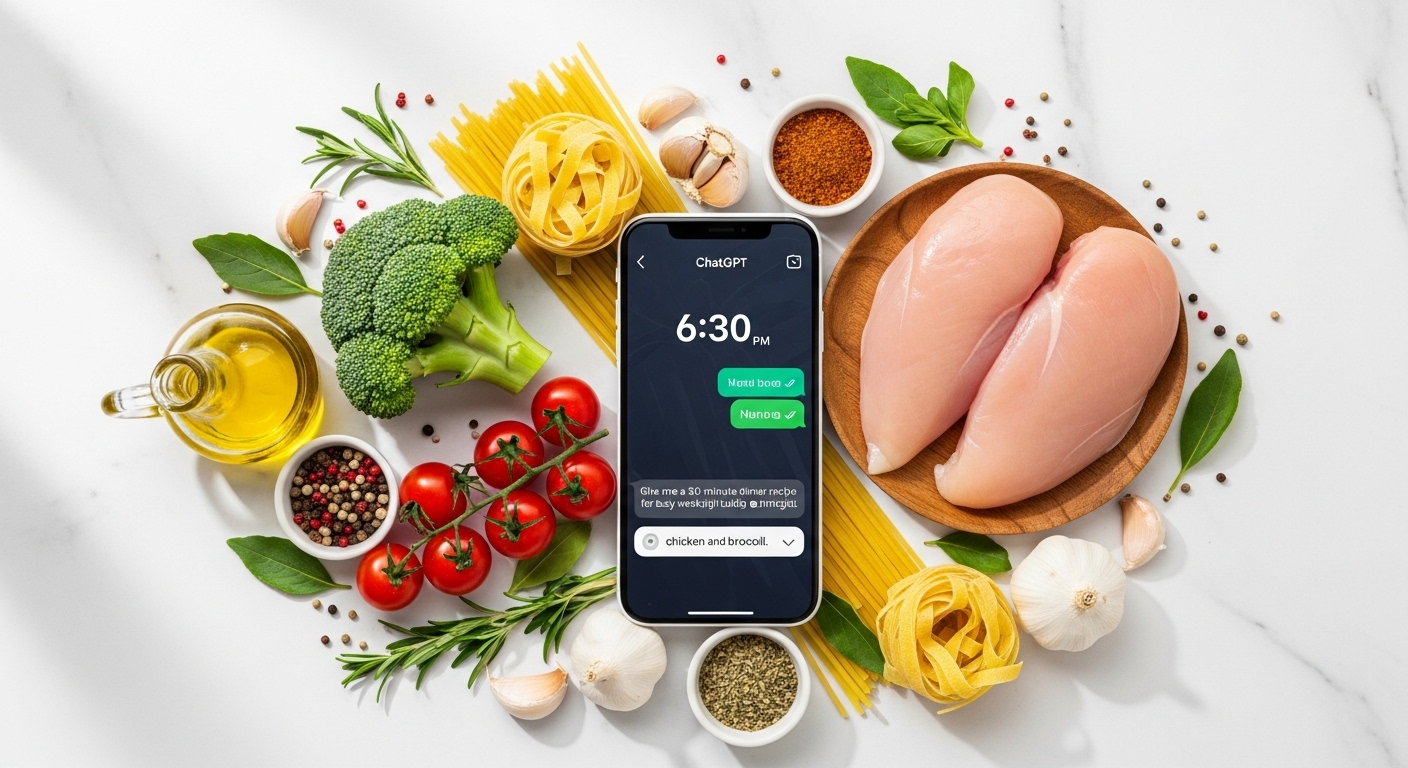
What if you could get genuinely achievable 30-minute dinner recipes tailored to ingredients you actually have, equipment in your kitchen, and skill level you possess? What if ChatGPT could create weeknight strategies accounting for your family’s preferences, dietary needs, and the reality that some nights you have 15 minutes, not 30? That’s exactly what these 20 ChatGPT prompts will help you achieve: real solutions for feeding your family nutritious meals without the takeout habit or evening stress.
Why Most Quick Dinner Strategies Fail
Before diving into the prompts, let’s understand why weeknight cooking feels impossible:
Recipe timing is aspirational, not realistic. “Prep time: 10 minutes” assumes professional knife skills, pre-measured ingredients, and no interruptions from children or pets. For normal humans, add 50% to any stated time.
Ingredient lists require full pantries. Recipes call for fish sauce, fresh herbs, specialty cheeses, and assume you keep these stocked. Reality: you have pasta, canned tomatoes, and questionable vegetables in the crisper drawer.
Cleanup is ignored in timing. A 30-minute recipe that uses every pot in your kitchen and leaves the counter covered in flour isn’t actually quick when you factor in the aftermath.
One-pot claims are often lies. “One-pot pasta” conveniently forgets about the pan you used to cook the protein first or the cutting board now covered in onion remnants.
Family preferences get ignored. Pinterest shows beautiful grain bowls with roasted vegetables. Your kids won’t touch anything that isn’t beige. Cooking food nobody eats wastes more time than ordering pizza.
Energy levels vary wildly. Monday you might manage a proper stir-fry. Thursday after three meetings and a school crisis, boiling water feels like a heroic achievement.
Meal planning sounds great but fails. You plan Sunday, shop Monday, and by Wednesday the planned meals don’t match your actual energy or ingredient freshness. Rigid plans collapse under real life.
ChatGPT can create flexible dinner strategies matching your actual circumstances: available time, energy level, ingredients on hand, family preferences, and cooking skill. No more aspirational recipes that set you up for failure.
How to Use These Prompts for Weeknight Success
Getting maximum value from these prompts requires honest information and realistic expectations:
Be truthful about your time. If you have 20 minutes max, say 20 minutes. Pretending you have 45 minutes just means ChatGPT suggests something you can’t execute.
List what you actually have. Your fridge inventory, pantry staples, and equipment. ChatGPT can work with what exists, but needs accurate information.
Specify family preferences and restrictions. “My 6-year-old only eats pasta and chicken” is valuable information. Dietary restrictions, allergies, texture issues all matter.
Acknowledge your skill level. If you’ve never made a stir-fry, asking for complex wok techniques guarantees frustration. Be honest about comfort with cooking techniques.
Define your flexibility. Can you prep anything the night before? Will you accept leftovers? These expand your options significantly.
Note your priorities. Nutrition, budget, minimal cleanup, kid-friendly, or just “everyone gets fed” all lead to different recommendations.
Now let’s explore the prompts, organized by situation type and constraint.
Emergency and Ultra-Quick Prompts
1. The 15-Minute Absolute Emergency Meal
I have 15 minutes maximum before family meltdown. What's actually in my kitchen: [list proteins, carbs, vegetables, pantry items you have RIGHT NOW]. Equipment: [stove/microwave/instant pot/air fryer available]. Dietary notes: [allergies, strong dislikes]. Create a meal using ONLY these ingredients that takes truly 15 minutes start to finish, including any prep. No "meanwhile, chop while other thing cooks" unless it's genuinely parallel tasks. I need step-by-step timing: minute 1-3 do this, minute 4-8 do that. Make this realistic for someone who's exhausted, not a cooking show contestant.
Why this works: This prompt forces realistic timing by requiring accounting for every minute. No aspirational multitasking that doesn’t actually happen when you’re fried.
2. The No-Thinking Required Formula
I'm completely brain-dead from the day and cannot handle complex recipes. Create a dinner using the formula: [protein I have] + [vegetable I have] + [carb I have] + [simple cooking method]. Available: [list what you have]. Preferences: [family requirements]. Give me the absolute simplest preparation: season with X, cook for Y minutes, done. No recipe following, no measuring beyond "enough to feed [number] people." Explain the basic technique so I understand the principle, not just this meal. Sometimes I just need "put chicken and vegetables on sheet pan, roast 25 minutes" level simplicity.
Why this works: Decision fatigue is real. This prompt creates foolproof formulas requiring minimal mental energy, perfect for exhausted weeknights.
3. The Pantry and Freezer Rescue Mission
I forgot to plan dinner and haven't grocery shopped. What I have: [pantry staples: pasta, rice, canned goods], [freezer: proteins, vegetables], [random fridge items]. I have [time available]. Create 3 different dinner options from ONLY these ingredients, no store run. Rank by: (1) quickest, (2) most nutritious, (3) most kid-friendly. Include defrosting time if needed. Show me how pantry staples and freezer items can actually create real meals, not just "eat cereal for dinner" nights.
Why this works: This prompt proves you don’t always need fresh ingredients. Strategic pantry and freezer stocking enables quick meals without shopping.
Strategy and Planning Prompts
4. The Flexible Weekly Framework
I need a weeknight dinner framework, not rigid meal plan. My situation: [work schedule, kids' activities, typical energy levels by day]. Family size: [number], preferences: [list], available prep time varies: [Monday might be 45 min, Friday might be 15 min]. Create a flexible strategy: (1) 2-3 "real cooking" meals for higher-energy nights. (2) 2-3 "assembly" meals for medium energy. (3) 2 "rescue" meals for survival mode. (4) Ingredient overlap so shopping is efficient. (5) Leftover transformation plan. (6) How to adjust when Wednesday's plan doesn't match Wednesday's reality. Make this adaptable, not rigid.
Why this works: Rigid meal plans fail when life happens. Flexible frameworks with difficulty tiers accommodate energy variation while preventing decision paralysis.
5. The Batch Cooking Integration
I can cook on [day/time] but weeknights are chaos. Help me batch cook strategically: What should I prepare in advance that: (1) Reheats well or gets used cold. (2) Becomes multiple different meals, not just portions of the same thing. (3) Stores safely for [how many days]. (4) Requires minimal finishing on weeknights. I have [time available for batch cooking], equipment: [list], family preferences: [specify]. Create a Sunday session plan producing [number] weeknight meals with specific what-to-make and how-to-use strategies. Include storage and reheating instructions.
Why this works: Strategic batch cooking means cooking once, eating multiple times differently. This prompt creates transformation strategies, not just reheating.
6. The Rotational Menu System
I'm tired of deciding what's for dinner every single day. Create a rotating menu system: [number] weeks of dinners that repeat, providing variety while removing decision fatigue. Family preferences: [list], dietary needs: [specify], budget: [realistic amount], cooking skill: [honest assessment]. For each week, provide: (1) 5-7 dinners with shopping list. (2) Variety across protein types, cuisines, preparation methods. (3) Strategic ingredient overlap within the week. (4) Flexibility points where I can substitute based on sales or availability. Make rotation feel varied, not monotonous, while being genuinely executable.
Why this works: Decision fatigue is exhausting. A good rotation removes daily decisions while providing enough variety to prevent boredom.
Dietary and Preference-Specific Prompts
7. The Picky Eater Survival Strategy
I'm feeding extremely picky eaters. Will eat: [list very limited safe foods]. Absolutely refuse: [list rejected foods]. Age: [specify], texture issues: [describe if applicable]. I still need somewhat balanced nutrition. Create: (1) Meals using accepted ingredients in ways that feel different (chicken nuggets vs chicken stir-fry, both "safe" but varied). (2) Gradual expansion strategy: foods similar to accepted ones. (3) Deconstructed meals where picky eaters can choose components. (4) Hidden nutrition when possible (vegetables blended into sauces). (5) Realistic expectations: what nutrition can wait versus must-haves. (6) Keeping my sanity while not making multiple meals. Help me feed picky eaters without becoming a short-order cook.
Why this works: Picky eating is common and challenging. This prompt creates strategies working within limitations while maintaining parental sanity.
8. The Budget-Conscious Quick Meal
I need fast dinners that don't destroy my budget. Weekly dinner budget: $[amount] for [household size]. Time limit: [30 minutes or less]. Access to: [discount stores, regular grocery, bulk options]. Create meal strategies: (1) Affordable proteins that cook quickly (eggs, canned beans, cheaper cuts). (2) Seasonal vegetable usage. (3) Stretching ingredients (one chicken makes three meals). (4) Cheap staples maximized (rice, pasta, potatoes prepared differently). (5) Avoiding expensive convenience (making own versus buying prepared). (6) Strategic use of loss leaders or sales. Show me cost per serving for each meal and prove quick doesn't mean expensive.
Why this works: Budget constraints are real but don’t preclude quick cooking. This prompt proves affordable and fast can coexist.
9. The Healthy Quick Dinner Optimizer
I want legitimately nutritious dinners, not just "healthy-ish." Health goals: [weight management, muscle building, general wellness, specific health condition]. Time: [available], cooking ability: [level]. Create balanced meals with: (1) Adequate protein (specify target grams). (2) Vegetables actually included, not aspirational. (3) Whole grains or complex carbs when appropriate. (4) Healthy fats in reasonable amounts. (5) Portion guidance. (6) Nutrient density without requiring exotic superfoods. Make these truly quick while genuinely nutritious, not health-washed junk food. Include macro breakdowns if relevant to my goals.
Why this works: “Healthy” is vague and often means expensive or time-consuming. This prompt defines specific nutrition goals and achieves them realistically.
Cooking Method and Equipment Prompts
10. The One-Pan Wonder Generator
I hate cleanup almost as much as I hate cooking when exhausted. Create genuinely one-pan dinners using [cooking method: sheet pan/skillet/Dutch oven]. Family size: [number], preferences: [list], time: [available]. True one-pan means: (1) Protein and sides cook together with similar timing. (2) No other pans for prep steps. (3) Minimal cutting board use. (4) Easy cleanup (line pan with foil, or pan that cleans easily). Generate 5 different one-pan meals with specific instructions: what goes in when, temperature, timing. Make cleanup truly minimal, not "one main pan plus five prep dishes."
Why this works: Cleanup time is real time. Genuinely minimal-dish meals reduce total cooking burden significantly.
11. The Instant Pot Weeknight Formula
I have an Instant Pot but only use it for basic things. Teach me weeknight Instant Pot strategies. Time available: [total including pressure time], family preferences: [list], ingredients I typically have: [proteins, vegetables, grains]. Create: (1) Dump-and-go recipes (everything in pot, set timer). (2) Recipes using pressure cooking time efficiently (10-minute pressure, natural release while I do other things). (3) One-pot complete meals (protein, starch, vegetable together). (4) How to adapt regular recipes to Instant Pot. (5) Common mistakes to avoid. Make Instant Pot a weeknight hero, not occasional slow-cooker replacement.
Why this works: Instant Pots are underutilized because people don’t understand their weeknight potential. This prompt unlocks fast pressure cooking strategies.
12. The Air Fryer Quick Dinner System
I have an air fryer and want to maximize its weeknight usefulness. Time limit: [specify], family size: [number], preferences: [list]. Create air fryer dinner strategies: (1) Proteins that air fry well and quickly. (2) Vegetables that roast fast in air fryer. (3) Cooking timing for different items (sequential cooking or everything together). (4) Batch cooking in air fryer for multiple nights. (5) Foods that taste better air-fried than other methods. (6) Temperature and timing guides for common ingredients. Transform air fryer from snack maker to dinner solution.
Why this works: Air fryers cook faster than ovens but many people only make frozen foods. This prompt reveals dinner-worthy air fryer applications.
Cuisine and Flavor Variety Prompts
13. The Global Flavor 30-Minute Tour
I'm stuck in a rut making the same five dinners. Introduce variety through different cuisines, all achievable in 30 minutes or less. Family tolerance for adventurous: [conservative/moderate/adventurous], ingredients I have access to: [standard grocery/international market/Asian grocery]. Create quick versions of: (1) Asian stir-fries or noodles. (2) Mexican tacos, burrito bowls, quesadillas. (3) Italian pasta or risotto variations. (4) Mediterranean grain bowls or sheet pan dinners. (5) American comfort food. For each cuisine, provide 2-3 quick dinner options with ingredient accessibility and modification suggestions. Expand my repertoire without requiring specialty shops.
Why this works: Variety prevents dinner rut but requires accessible strategies. This prompt introduces diverse flavors using available ingredients.
14. The Seasonal Quick Dinner Rotation
I want to cook seasonally for better taste and prices. My location: [general region/climate]. Create seasonal 30-minute dinner guides: (1) Spring: what produce is fresh, quick recipes using it. (2) Summer: peak season ingredients, minimal cooking in heat. (3) Fall: hearty but quick meals with autumn produce. (4) Winter: comfort food achieved quickly. For each season, provide 5 dinners maximizing seasonal ingredients at their cheapest and best. Include why seasonal matters beyond price (taste, nutrition, sustainability).
Why this works: Seasonal cooking improves taste and reduces cost but requires knowing what’s in season. This prompt creates seasonal frameworks.
Leftover and Waste Prevention Prompts
15. The Planned Leftover Strategy
I waste so much food by making random meals without thinking about using leftovers. Create an intentional leftover system: (1) Monday's dinner intentionally makes components for Wednesday (roast chicken becomes soup or tacos). (2) Batch components used differently (one batch of rice becomes fried rice, rice bowls, stuffed peppers). (3) Vegetable scraps saved for quick stock. (4) Leftover transformation recipes that don't taste like "leftovers again." (5) Storage strategies ensuring ingredients stay fresh for planned reuse. Design a week where nothing goes to waste because everything has a purpose.
Why this works: Strategic leftovers differ from accidental ones. This prompt creates intentional systems where cooking once serves multiple meals.
16. The Refrigerator Clean-Out Creator
I have random ingredients that need using before they spoil: [list current fridge/pantry items with freshness status]. Create a "clean-out" dinner using maximum ingredients before anything goes bad. Preferences: [family requirements], time: [available]. Show me how to: (1) Combine seemingly unrelated ingredients coherently. (2) Determine which items to prioritize by spoilage risk. (3) Add minimal staples to make it work. (4) Create something actually appetizing, not just "use it up" desperation. Teach me to see clean-out dinners as creative challenges, not burdens.
Why this works: Preventing waste requires creative use of random ingredients. This prompt teaches improvisation within constraints.
Skill Building and Technique Prompts
17. The Core Technique Mastery
Instead of following recipes blindly, teach me core quick-cooking techniques I can adapt infinitely. I want to master: (1) Basic stir-fry (any protein + any vegetables + any sauce). (2) Sheet pan dinners (protein + vegetables, timing coordination). (3) Pasta with variations (different sauces, additions). (4) Grain bowls (building blocks approach). (5) Tacos/wraps (protein + toppings formula). For each, explain: the technique, timing principles, common mistakes, infinite variations. Make me confident improvising rather than dependent on recipes.
Why this works: Technique mastery beats recipe collection. Understanding principles enables infinite adaptation to available ingredients.
18. The Weeknight Troubleshooting Guide
Common quick-dinner failures I experience: [describe what goes wrong: chicken always dry, pasta too mushy, timing off, flavors bland]. Diagnose and fix: (1) Why does X keep happening? (2) What am I misunderstanding about technique or timing? (3) Specific corrections for each problem. (4) How to tell when things are properly done versus guessing. (5) Preventive strategies so failures don't repeat. Make me better at quick cooking through understanding mistakes, not just giving me more recipes.
Why this works: Learning from failures prevents repeated mistakes. This prompt diagnoses technique problems preventing consistent success.
Special Situation Prompts
19. The No-Cook or Minimal-Cook Emergency
It's too hot to cook, I'm too exhausted, or the stove is broken. Create dinners requiring minimal or no cooking. Available: [appliances working: microwave/toaster/blender], ingredients: [what I have]. Preferences: [family needs]. Generate meals that: (1) Require no heat or minimal microwave only. (2) Are actually satisfying, not just snack plates. (3) Provide adequate nutrition despite no cooking. (4) Feel like real dinner, not emergency rations. (5) Can be assembled in under 15 minutes. Save me from ordering pizza when cooking isn't possible.
Why this works: Sometimes cooking isn’t viable. This prompt creates legitimate dinner options without traditional cooking.
20. The Meal Prep Support for Beginners
I hear meal prep helps weeknight dinners but don't know where to start. I have [time available on weekend]. Family needs: [size, preferences], goal: make [number] weeknight dinners easier. Create beginner meal prep: (1) What to prep versus make fresh (chopped vegetables, cooked grains, marinated proteins). (2) Storage containers and organization. (3) Which prep helps most (the 20% that gives 80% weeknight benefit). (4) How to use prepped items without everything being the same meal. (5) Realistic expectations: what meal prep can and can't solve. Start me on sustainable meal prep, not overwhelming Pinterest perfection.
Why this works: Meal prep intimidates beginners. This prompt creates accessible entry points focusing on high-impact preparation.
Your Weeknight Dinner Success Starts Tonight
You now have 20 powerful ChatGPT prompts that transform weeknight dinners from daily panic into systematic solutions. These prompts don’t provide generic quick recipes. They create personalized strategies matching your actual time, ingredients, skill level, and family dynamics.
The difference between people who cook successful weeknight dinners and those ordering takeout constantly isn’t cooking ability or available time. It’s having strategies that match reality: flexible frameworks, ingredient-based improvisation, and realistic timing.
Here’s your action plan starting today: Stop pretending you’ll follow elaborate meal plans or cook complex recipes after exhausting days. Stop ordering expensive takeout because nothing else seems possible. Stop feeling guilty about dinner failures.
Instead, assess tonight’s reality honestly. How much time do you actually have? What ingredients are currently in your kitchen? What’s your energy level on a scale of 1-10?
Choose one prompt matching tonight’s situation. Maybe it’s the 15-Minute Emergency for when you’re already late. Or the Pantry Rescue when you haven’t shopped. Or the No-Thinking Formula when you’re brain-dead.
Open ChatGPT right now. Paste your chosen prompt with honest details about your situation. Get a realistic dinner plan you can actually execute, not aspirational cooking you’ll abandon.
Make that dinner tonight. Time yourself. Note what worked and what didn’t. Use this data to refine future prompts.
Build your personal quick dinner database. When you find a winner, save it. Track which formulas work on which days. Your accumulated knowledge creates increasingly efficient weeknight cooking.
The version of yourself who cooks real dinners on busy weeknights, feeds your family nutritious meals, and saves money on takeout isn’t built through willpower or cooking classes.
It’s built through realistic strategies matching your actual circumstances, flexible frameworks accommodating energy variation, and recipes that genuinely take the time they claim.
Your successful weeknight dinners don’t require hours, exotic ingredients, or professional skills. They require honest assessment, strategic thinking, and solutions designed for real life, not food blogs.
Your home-cooked dinner is one realistic prompt away. Stop aspiring to impossible standards. Start cooking what actually works.
What are you making tonight?