Let’s be honest—you’ve been drinking mediocre coffee for years and didn’t even know it. You thought that bitter, burnt-tasting brew from your drip machine was just “how coffee tastes,” or that spending $6 on a coffee shop latte was the only way to get something actually good. Meanwhile, coffee nerds are pulling espresso shots that taste like chocolate and berries, brewing pour-overs that rival anything from fancy cafés, and spending less per cup than you do on your Starbucks habit.
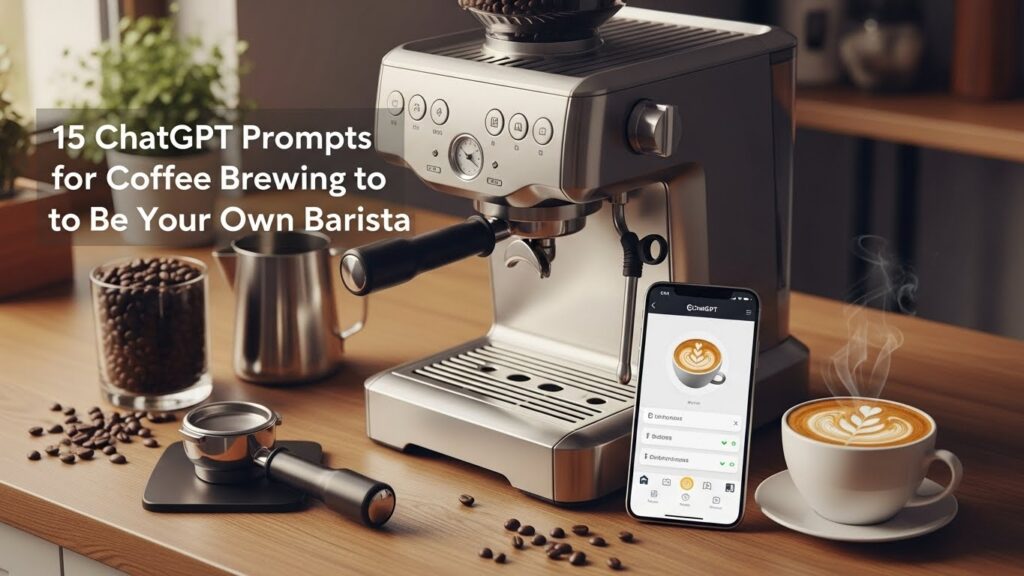
Here’s the uncomfortable truth: the gap between your coffee and great coffee isn’t equipment cost or exotic beans—it’s knowledge. Professional baristas understand extraction science, grind size impact, water chemistry, and brewing ratios. You’re winging it with grocery store pre-ground coffee, tap water, and whatever brewing method came with your machine. The result? You’re extracting only 50% of coffee’s potential flavor while wondering why home coffee never tastes as good as café coffee.
What if you could brew coffee that rivals professional cafés using equipment you already own or can buy for less than a month of coffee shop visits? What if you understood the science well enough to troubleshoot any brewing problem and consistently produce excellent coffee? That’s exactly what these 15 ChatGPT prompts will help you achieve—barista-level coffee knowledge and technique without the expensive training or trial-and-error experimentation.
Why Your Coffee Probably Tastes Bad (And You Don’t Know It)
Before diving into the prompts, let’s understand why most home coffee is disappointing:
You’re brewing with the wrong ratio. Most people use way too little coffee for their water amount, creating weak, under-extracted brews that taste watery and sour. The “scoop per cup” method is nonsense—coffee needs precision.
Your grind size is wrong for your method. French press with espresso-fine grounds? You’ll get bitter sludge. Pour-over with coarse grounds? Sour, weak tea. Each brewing method requires specific grind sizes that most people never adjust.
Your water is sabotaging flavor. Tap water with high chlorine, wrong mineral content, or extreme pH creates off-flavors that overpower coffee’s natural characteristics. Water is 98% of your cup—it matters enormously.
Temperature inconsistency ruins extraction. Too hot (over 205°F) and you over-extract bitterness. Too cool (under 195°F) and you under-extract sourness. Most automatic machines don’t reach proper temperature.
Your beans are already stale. That grocery store bag labeled “fresh”? It was roasted months ago. Coffee peaks 3-14 days after roasting and degrades rapidly after opening. Pre-ground? You’re brewing coffee dust, not fresh beans.
You don’t understand extraction. Coffee brewing is extraction science—pulling desirable compounds from beans while leaving behind undesirable ones. Without understanding this, you’re randomly hoping for good results.
Equipment limitations aren’t compensated for. Every brewing method has weaknesses. Good baristas work around these limitations through technique. You’re letting equipment weaknesses dominate your results.
ChatGPT can teach you the science, troubleshoot your specific problems, and provide technique refinements that transform your coffee from “caffeinated” to genuinely delicious.
How to Use These Prompts for Barista-Level Coffee
Getting maximum value from these prompts requires honest assessment and willingness to experiment:
Identify your current setup. What equipment do you have? What coffee are you using? What’s your water source? Specific details enable specific advice.
Define what “good coffee” means to you. Preference matters. Some love bright, acidic coffee; others prefer dark, bold roasts. Understanding your taste guides decisions.
Be willing to change one variable at a time. Coffee troubleshooting requires isolating variables. Change grind size OR ratio OR temperature—not everything simultaneously.
Invest in basics if needed. A $20 scale and $40 burr grinder transform coffee more than $200 in fancy gear without fundamentals.
Taste critically and descriptively. “Tastes bad” doesn’t help troubleshooting. “Tastes sour and weak” or “bitter and harsh” guides specific fixes.
Keep notes on what works. Coffee memory is unreliable. Write down your recipes when you nail something delicious.
Now let’s explore the prompts, organized by coffee knowledge area and skill level.
Coffee Fundamentals and Bean Selection Prompts
1. The Coffee Bean Education Deep Dive
I want to understand coffee beans beyond "light, medium, dark roast." Teach me: (1) How origin affects flavor—what makes Ethiopian coffee different from Colombian or Sumatran? (2) Processing methods—washed vs. natural vs. honey—and how each impacts taste. (3) Roast levels—what actually happens during roasting and how it changes flavor compounds? (4) How to read a coffee bag—what do terms like "single origin," "blend," "altitude," and roast dates actually tell me? (5) What freshness really means—when is coffee actually "fresh" and how long does it stay good? (6) How to identify quality beans versus marketing hype. I want to make informed buying decisions, not just grab whatever's on sale.
Why this works: Understanding beans is fundamental. This prompt builds knowledge that informs every subsequent decision—what to buy, how to brew it, and what flavors to expect.
2. The Personal Coffee Profile Identifier
Help me identify my coffee taste preferences so I can buy beans I'll actually enjoy. I'll describe coffees I've liked and disliked: [describe specific coffee experiences—café drinks, home brews, specific brands]. Based on this, analyze: (1) Do I prefer light, medium, or dark roasts? (2) What flavor notes appeal to me—fruity, nutty, chocolatey, floral, earthy? (3) Do I like bright acidity or smooth body? (4) Single origin or blends? (5) What origins and processing methods match my preferences? Then create a specific bean-buying guide: what to look for on bags, what origins to try, what to avoid. I'm tired of buying random coffee hoping it'll be good—I want a strategy.
Why this works: Knowing your preferences prevents wasting money on coffee you won’t enjoy. This prompt creates a personalized buying framework based on your actual taste, not generic recommendations.
3. The Coffee Storage and Freshness Optimization
I want to maximize coffee freshness from purchase to final cup. Current setup: I buy [amount] of coffee at a time, store it in [container/location], and grind [when]. Help me optimize: (1) How much coffee should I buy at once given my consumption rate? (2) Best storage container and location—what actually matters versus marketing? (3) Should I freeze coffee? When does this help versus hurt? (4) Grind immediately before brewing versus advance grinding—real impact? (5) How to tell when coffee is past its prime—specific signs beyond "tastes bad." (6) Storage strategies for opened bags versus whole beans versus ground. Give me a realistic freshness system I'll actually follow, not some idealistic approach requiring specialty equipment.
Why this works: Fresh coffee makes the biggest flavor difference. This prompt creates practical freshness management that fits real life, not café ideals.
Brewing Fundamentals and Technique Prompts
4. The Universal Brewing Ratio and Recipe Builder
I'm confused about coffee-to-water ratios. I have: [brewing method]. Walk me through: (1) The standard ratio for this method in terms I can actually use (grams, tablespoons, whatever makes sense). (2) How to scale this ratio for different serving sizes. (3) When and why to adjust the ratio—what does stronger/weaker ratio actually change? (4) How this ratio interacts with grind size and brew time. (5) Give me 3 specific recipes for my method: standard, strong, and mild, with exact measurements. (6) How to troubleshoot ratio problems—if coffee tastes [specific way], should I use more/less coffee? I need concrete numbers I can replicate, not vague "to taste" guidance.
Why this works: Ratio is the foundation of repeatable results. This prompt provides specific, measurable recipes for your exact brewing method, eliminating guesswork.
5. The Grind Size Mastery Guide
Explain grind size like I'm five, then help me dial it in for [brewing method]. Cover: (1) Why grind size matters—what actually happens during extraction at different sizes? (2) Describe the correct grind size for my method using comparisons I can see/feel (table salt, sand, etc.). (3) How to tell if my grind is too fine or too coarse based on taste—specific flavor indicators. (4) How grind size interacts with brew time and temperature. (5) If I'm using [grinder type], what setting should I start with? (6) Step-by-step adjustment process: if coffee tastes X, make grind Y adjustment. I want to understand the logic, not memorize random settings.
Why this works: Grind size might be the most important variable in coffee brewing. This prompt teaches both the science and practical adjustment process for your specific equipment.
6. The Water Chemistry Coffee Optimization
How does my water affect coffee? My water source: [tap/filtered/bottled, and location if relevant]. Help me: (1) Understand what water chemistry matters—minerals, pH, chlorine, hardness. (2) How to test my water or recognize problems by taste. (3) Whether my water is suitable for coffee or needs treatment. (4) Options for improving water—filters, bottled water, remineralization—with cost/benefit analysis. (5) Specific water recommendations for my brewing method. (6) How much difference water actually makes—is this worth investing in or marginal? I've heard water matters but don't know if this is coffee snob territory or legitimately important.
Why this works: Water is 98% of your cup but most overlooked. This prompt assesses your specific water situation and provides targeted improvements without unnecessary expense.
Method-Specific Brewing Prompts
7. The Pour-Over Perfect Technique
I want to master pour-over coffee using [V60/Chemex/Kalita/other]. My current process: [describe your current technique]. Help me refine: (1) Exact grind size for my dripper. (2) Optimal water temperature—does it vary during brewing? (3) Pour technique—bloom phase, number of pours, pour pattern, total time. (4) How to control extraction through pouring—faster/slower, center/edges, continuous/pulsed. (5) Common mistakes specific to my dripper type. (6) Step-by-step recipe with timing for [serving size]. (7) Troubleshooting guide: if coffee tastes X, adjust Y. I want to understand WHY each step matters, not just follow a recipe blindly.
Why this works: Pour-over offers incredible control but requires technique understanding. This prompt provides method-specific mastery for your exact equipment.
8. The French Press Excellence Protocol
Everyone says French press is easy, but mine tastes muddy and bitter. My setup: [press size, current technique]. Diagnose and fix: (1) Correct grind size—I've heard "coarse" but what does that actually mean for French press? (2) Optimal ratio—most recipes seem random. (3) Brew time—I've seen everything from 3-10 minutes recommended. (4) Water temperature and why it matters here. (5) Plunge technique—does speed matter? Full pressure or gentle? (6) How to minimize sediment without sacrificing body. (7) Cleaning impact on taste—how thorough must I be? Give me a foolproof process that produces clean, full-bodied French press without the common problems.
Why this works: French press seems simple but has specific technique requirements. This prompt addresses the method’s unique challenges and common failure points.
9. The Espresso Home Mastery Guide
I have [espresso machine and grinder models]. I want to pull café-quality shots at home. Current results: [describe your shots]. Walk me through: (1) Dialing in—step-by-step process to find the right grind, dose, and time. (2) What "good" espresso should taste like—how do I know when I've nailed it? (3) Puck preparation—distribution, tamping pressure and technique. (4) Extraction timing and visual cues—what should I see? (5) Common problems and fixes: channeling, fast/slow shots, sour/bitter results. (6) Machine-specific tips for my equipment. (7) Realistic expectations—what can my setup produce versus commercial machines? I want to maximize my equipment's potential, not chase impossible café replication.
Why this works: Espresso is the most technical brewing method with the steepest learning curve. This prompt provides equipment-specific guidance that respects your gear’s limitations while maximizing results.
10. The Cold Brew and Iced Coffee Mastery
I want to make great cold coffee—both cold brew concentrate and iced coffee methods. Cover: (1) Cold brew—grind size, ratio, steep time, water temperature (or room temp?). (2) Concentrate vs. ready-to-drink approaches—pros/cons of each. (3) How to dilute concentrate properly—what ratio preserves flavor? (4) Japanese iced coffee method—what is it and when is it better? (5) Flash-chilled techniques versus brewing hot. (6) Storage—how long does cold brew stay good? (7) Common mistakes that create bitter or weak results. I want cold coffee that's actually good, not just caffeinated and cold.
Why this works: Cold coffee requires different approaches than hot brewing. This prompt covers multiple methods with specific techniques for each, preventing common cold-brew mistakes.
Troubleshooting and Problem-Solving Prompts
11. The Coffee Taste Problem Diagnostic
My coffee tastes [describe specific problem: sour, bitter, weak, harsh, flat, etc.]. My setup: [equipment, beans, grind, ratio, process]. Diagnose the problem: (1) What causes this specific taste issue—under-extraction, over-extraction, other factors? (2) Which variable is most likely the culprit given my description? (3) Step-by-step troubleshooting—what should I adjust first, second, third? (4) How to test whether I've fixed it or need further adjustment. (5) Preventive measures so this doesn't happen again. Use my specific taste description to pinpoint the issue—don't give me generic "coffee troubleshooting" advice that covers everything.
Why this works: Taste-based troubleshooting is more useful than random experimentation. This prompt uses your specific problem to identify likely causes and systematic fixes.
12. The Brewing Consistency Achievement System
My coffee is inconsistent—sometimes great, usually mediocre, occasionally terrible. I can't figure out what I'm doing differently. Help me achieve consistency: (1) What variables am I probably not controlling—identify common sources of variation. (2) Create a brewing checklist/recipe card for my method that ensures repeatability. (3) How to measure/weigh/time accurately with equipment I have or can afford. (4) What notes should I keep to identify patterns in good versus bad batches? (5) Environmental factors I might be ignoring—room temperature, bean age, water freshness. (6) Build a simple system that makes consistency automatic, not something requiring intense focus every morning.
Why this works: Inconsistency is frustrating and prevents improvement. This prompt creates systematic controls that deliver reliable results regardless of morning brain fog.
Advanced Technique and Experimentation Prompts
13. The Coffee Roast and Origin Pairing Guide
I want to understand how different origins and roast levels work with different brewing methods. Explain: (1) Which origins/profiles work best with which brewing methods and why? (2) How should I adjust technique when switching from light to dark roast? (3) Flavor potential of different origin regions—what to expect from Ethiopia, Colombia, Sumatra, Kenya, etc. (4) How processing method (washed, natural, honey) changes brewing considerations. (5) When to choose single origin versus blends for my method. (6) Create a decision framework: if I like [flavor characteristics], I should try [origins/roasts] brewed with [method] using [technique adjustments]. Turn my preferences into actionable buying and brewing strategy.
Why this works: Origin and roast dramatically affect optimal brewing technique. This prompt matches beans to methods and adjusts technique accordingly, preventing mismatch disappointments.
14. The Milk-Based Coffee Drink Crafting
I want to make café-quality lattes and cappuccinos at home. My equipment: [machine or alternative]. Teach me: (1) How to steam/froth milk properly—temperature, texture, technique for my equipment. (2) If I don't have a steam wand, what are realistic alternatives? (3) Milk choice impact—whole, 2%, oat, almond—how does each behave? (4) Pour technique for latte art basics (or at least not-ugly pours). (5) Proper ratios—what makes a cappuccino vs. latte vs. cortado different? (6) Common mistakes that create scalded milk or weak drinks. (7) Whether expensive milk frothers are worth it or if cheap options work fine. I want delicious milk drinks, not necessarily Instagram-worthy ones.
Why this works: Milk drinks require techniques beyond just brewing coffee. This prompt addresses milk-specific skills with equipment-appropriate recommendations.
15. The Coffee Experimentation and Recipe Development
I want to start experimenting and developing my own recipes. I understand basics but want to go deeper. Guide me through: (1) How to design experiments—what to change, what to hold constant, how to evaluate results. (2) Advanced technique variations—bloom time, pulse pouring, temperature stepping, turbulence vs. gentle extraction. (3) Unconventional approaches worth trying—different water recipes, unusual ratios, hybrid methods. (4) How to document experiments so I can replicate successes and learn from failures. (5) When experimentation is useful versus when it's just making coffee weird. (6) Resources or frameworks for continuing education beyond basics. Help me graduate from following recipes to understanding deeply enough to create my own.
Why this works: Mastery comes from understanding principles well enough to experiment intelligently. This prompt guides systematic exploration that builds expertise beyond recipe-following.
Advanced Coffee Science and Knowledge
Beyond prompts, understanding coffee science deepens appreciation and capability:
The Chemistry of Extraction
Extraction is selective dissolution. Hot water pulls compounds from coffee grounds. Different compounds extract at different rates—acids extract quickly, sugars slowly, bitter compounds slowest.
Under-extraction creates sourness. When water doesn’t extract enough, you get acids without balancing sugars and subtle flavors. Usually caused by coarse grind, low temperature, or short contact time.
Over-extraction creates bitterness. When water extracts too much, including undesirable bitter compounds, coffee becomes harsh and astringent. Usually caused by fine grind, high temperature, or long contact time.
Target is 18-22% extraction. Specialty coffee aims to extract this percentage of coffee’s mass into water—enough for full flavor development without over-extraction.
Understanding Coffee Flavor
Origin determines inherent character. Soil, altitude, climate, and processing create baseline flavor profiles. Ethiopian coffee naturally tastes different from Brazilian coffee.
Roasting develops and transforms flavor. Light roasts preserve origin character with brighter acidity. Dark roasts develop roast character—caramelization, body, bitterness—that overshadows origin.
Brewing reveals what roasting created. Technique can’t create flavors that don’t exist in beans, but it can highlight certain characteristics or mask others.
Fresh coffee tastes better. Degassing immediately after roasting releases CO2. Too fresh (under 3 days) and CO2 interferes with brewing. Peak flavor window is typically 3-14 days post-roast, with slow decline after.
Equipment Investment Priority
Grinder matters most. Consistent grind size impacts extraction more than any other single factor. Burr grinders produce uniform particles; blade grinders create dust and boulders that extract poorly.
Scale enables precision. Measuring coffee and water by weight ensures repeatable ratios. $20 investment transforms consistency.
Kettle with temperature control helps. Consistent water temperature improves results, especially for pour-over methods. Gooseneck spout aids pour control.
Beans trump equipment. Fresh, quality beans brewed with basic technique beat stale grocery coffee in expensive machines. Prioritize beans.
Your Home Barista Journey Starts Now
You now have 15 powerful ChatGPT prompts that transform coffee brewing from hit-or-miss caffeine delivery into a skill you genuinely master. These prompts don’t just provide recipes—they build understanding that enables you to troubleshoot, experiment, and consistently produce excellent coffee.
The difference between people who drink mediocre coffee and those who brew café-quality drinks at home isn’t expensive equipment or exotic beans—it’s understanding the science, controlling the variables, and practicing techniques that anyone can learn.
Here’s your action plan starting tomorrow morning: Stop brewing coffee the same way you’ve been doing while hoping for different results. Stop accepting mediocrity because “coffee is coffee.” Stop wasting money on coffee shops when you could brew better at home.
Instead, identify your biggest coffee frustration. Maybe your coffee is consistently bitter. Or weak and flavorless. Or you can’t figure out why café coffee tastes so much better than yours.
Choose one prompt from this list that addresses that specific problem. Maybe it’s the Coffee Taste Problem Diagnostic. Or the Grind Size Mastery Guide. Or the method-specific prompt for your brewing equipment.
Open ChatGPT right now. Set aside 20 minutes to really engage with the prompt. Provide your specific details—exact equipment, current process, taste results. Get personalized guidance rather than generic coffee advice.
Then brew your next cup implementing what you learned. Change ONE variable based on the guidance. Taste critically. Did it improve? If yes, lock in that change and address the next issue. If no, try the next suggested adjustment.
Keep a simple coffee journal—even just notes in your phone. Date, beans used, grind setting, ratio, what you changed, how it tasted. Patterns emerge that guide continual improvement.
The version of yourself who brews genuinely delicious coffee every morning, who understands why certain adjustments work, and who saves hundreds monthly by not needing coffee shops isn’t built through expensive equipment purchases or magical beans.
It’s built through understanding principles, controlling variables, and deliberately practicing technique—all of which these prompts enable.
Your barista-level coffee doesn’t require a $3,000 espresso machine or rare Geisha beans. It requires knowledge, attention to detail, and willingness to adjust technique based on results.
Your delicious coffee is one informed brew away. Stop accepting mediocrity. Start mastering the craft.
What are you brewing tomorrow morning?