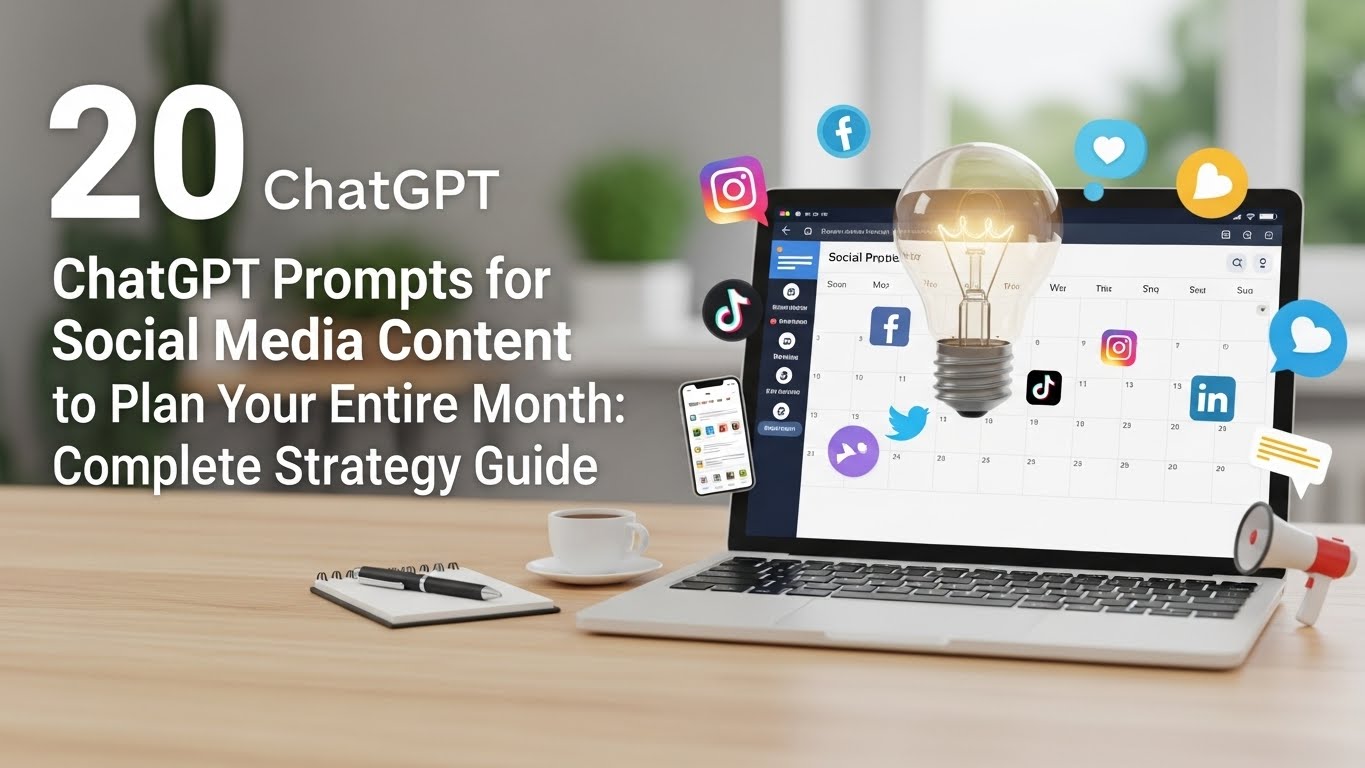
ChatGPT enables social media managers to plan comprehensive monthly content calendars using entity-centric frameworks, semantic connections, and intent-driven strategies. This guide contains 20 tested prompts that structure content around knowledge graphs, user intent prediction, and cross-platform optimization for maximum engagement and efficiency.
Part 1: Strategic Planning & Content Architecture Prompts
Prompt 1: Entity-Based Monthly Content Framework
Create 30-day social media content calendar using entity-centric approach for [brand/business type]. Structure content around these entity categories: 1) Product/Service entities (features, benefits, use cases), 2) Brand entities (values, story, team, mission), 3) Industry entities (trends, news, thought leadership), 4) Customer entities (testimonials, UGC, community highlights), 5) Educational entities (how-tos, tips, resources), 6) Engagement entities (questions, polls, challenges). For each category, identify semantic triples: '[Content type]' → 'achieves' → '[specific business goal]' → 'measured by' → '[KPI]'. Distribute across platforms: Instagram (visual storytelling), LinkedIn (professional authority), Twitter/X (real-time engagement), Facebook (community building), TikTok (entertainment/education). Assign 3 posts per category minimum, ensuring balanced weekly rhythm.
Why it works: Creates diverse, purpose-driven content mapped to measurable outcomes across entity types.
Prompt 2: Audience Intent Mapping & Content Pillars
Identify 5 core content pillars for [brand/industry] based on audience intent analysis. For each pillar: 1) Define the primary user intent (what audience seeks to learn/achieve/feel), 2) List 10 entity connections (topics, tools, concepts, people, trends within this pillar), 3) Create semantic triple structure: '[Pillar topic]' → 'addresses audience need for' → '[specific outcome]', 4) Generate 6 content ideas per pillar (varying formats: carousel, video, static, story, reel), 5) Map emotional journey: awareness → interest → consideration → advocacy. Each pillar should have distinct visual identity, hashtag strategy, and CTA pattern. Show how pillars interconnect through shared entities and seasonal themes.
Why it works: Builds cohesive content ecosystem that addresses complete audience journey while maintaining brand consistency.
Prompt 3: Competitive Content Gap Analysis
Analyze top 5 competitors in [industry/niche] to identify content gaps and opportunities. For each competitor: 1) Identify their dominant content entities (topics they cover most), 2) Map their semantic patterns: '[They post about X]' → 'targeting audience need Y' → 'missing opportunity Z', 3) List underserved entities in market (topics/formats competitors ignore), 4) Create differentiation triples: '[Our brand]' → 'uniquely offers' → '[content angle/entity connection competitors miss]'. Generate 20 content ideas that fill identified gaps, showing how each positions brand distinctively. Include content format, platform, key entities to feature, and competitive advantage explanation for each idea.
Why it works: Positions brand strategically by serving audience needs competitors overlook.
Prompt 4: Seasonal & Trend Integration Blueprint
Create content calendar integrating seasonal events, industry trends, and evergreen content for [month/quarter]. Structure as knowledge graph: [Brand] → central node connected to: 1) Seasonal entities (holidays, awareness months, cultural events with dates), 2) Trending entities (current platform features, viral formats, trending audio/hashtags), 3) Industry entities (conferences, product launches, regulatory changes, research releases), 4) Evergreen entities (timeless educational content, brand values, customer stories). For each entity, create semantic triple: '[Event/Trend]' → 'offers opportunity to' → '[specific content angle that serves audience + advances brand goal]'. Show weekly content distribution balancing 40% evergreen, 30% trending, 30% seasonal. Include backup content for trend-jacking opportunities.
Why it works: Maintains relevance through timely content while building enduring brand authority.
Prompt 5: Cross-Platform Content Remix Strategy
Design content creation system that produces 1 core asset yielding 15+ platform-specific variations. Start with [core content topic/entity]. Create semantic relationship map: '[Core content]' → 'contains sub-entities' → '[list 5-7 key concepts/data points/quotes/visuals]'. For each sub-entity, generate platform-specific adaptations: Instagram (visual hierarchy: feed post, story series, reel format), LinkedIn (professional angle: article, carousel, text post, poll), Twitter/X (thread structure, quote graphics, engagement questions), TikTok (entertainment hook, educational value, trending audio pairing), Pinterest (infographic, step-by-step guide), YouTube Shorts (script with hook/value/CTA). Specify how each variation maintains core message while optimizing for platform algorithm and user behavior. Include timing strategy for platform-specific posting windows.
Why it works: Maximizes content ROI through strategic repurposing while honoring platform-specific user expectations.
Part 2: Engagement & Community-Building Prompts
Prompt 6: Conversation-Starter Content Generator
Generate 30 engagement-focused posts designed to spark meaningful conversation for [brand/community]. Each post must: 1) Ask question or present scenario using entities relevant to audience (tools they use, challenges they face, goals they pursue), 2) Structure as semantic triple: '[Relatable situation]' → 'leads audience to share' → '[specific insight/experience]', 3) Include low-barrier participation option (emoji reaction, one-word answer, simple choice), 4) Build on current platform trends (question stickers, poll features, "This or That" formats). Categorize posts: 10 opinion-seeking (preferences, predictions), 10 experience-sharing (challenges, wins, tips), 10 interactive (polls, quizzes, caption contests). For each, write post copy, suggest optimal posting time, predict engagement patterns, and plan response strategy to continue conversation.
Why it works: Creates predictable engagement through strategic question design that audience wants to answer.
Prompt 7: User-Generated Content Campaign Framework
Design month-long UGC campaign for [brand/product] structured around content entities customers already create. Campaign name: [create memorable hashtag]. Semantic campaign structure: '[Customer experience with product]' → 'documented through' → '[specific content format]' → 'rewarded by' → '[incentive/recognition]'. Weekly themes: Week 1 - '[Entity: Product in daily use]', Week 2 - '[Entity: Before/after transformation]', Week 3 - '[Entity: Creative product applications]', Week 4 - '[Entity: Community connections]'. For each week: provide clear content brief with examples, submission guidelines, judging criteria, feature opportunities. Include: launch announcement posts, reminder/teaser posts, featured user highlights, engagement tactics (commenting on submissions), weekly winner announcements, campaign wrap-up with community gallery. Map semantic triples showing: '[UGC participation]' → 'strengthens' → '[community bonds + brand loyalty]'.
Why it works: Generates authentic content while deepening customer relationships through structured participation.
Prompt 8: Community Highlight & Social Proof System
Create monthly customer spotlight series transforming testimonials into engaging content entities. Structure: Select 8-10 customer stories representing different: use cases, demographics, success metrics, emotional journeys. For each spotlight, gather entities: customer name/business, specific problem faced, solution journey with product/service, measurable outcome, quotable moments, visual assets. Create content variations: 1) Instagram carousel (story arc over 6-8 slides using semantic structure: challenge → discovery → implementation → transformation → results), 2) Video testimonial script (60-90 seconds hitting emotional beats), 3) LinkedIn case study (professional angle with data), 4) Twitter thread (key insights with customer quotes), 5) Story takeover (customer shares day-in-life using product). Show semantic triple: '[Customer success]' → 'demonstrates' → '[product value]' → 'proves' → '[brand promise]'. Include posting schedule, tagging strategy, amplification plan.
Why it works: Builds trust through specific, relatable success stories across multiple content formats.
Prompt 9: Interactive Series & Content Loops
Design 3 recurring content series that create anticipation and habit formation for [audience]. Each series must: 1) Have memorable name and visual identity, 2) Consistent day/time (e.g., "Motivation Monday," "Friday Wins," "Tutorial Tuesday"), 3) Clear format audience recognizes, 4) Participation opportunity. For each series: define core entity focus, create 4-week content outline, establish semantic pattern that repeats: '[Series name]' → 'delivers' → '[specific value]' → 'invites audience to' → '[action]'. Series types: Educational (teaching entity-rich how-tos), Inspirational (mindset/motivation with actionable takeaway), Entertainment (industry humor, behind-scenes, relatable content), Community (spotlight members, crowdsource answers, collective challenges). Show how series interconnect to reinforce brand narrative and create content ecosystem that keeps audience returning.
Why it works: Builds viewing habits and predictable engagement through consistent value delivery.
Prompt 10: Crisis Response & Real-Time Engagement Protocol
Develop response framework for handling negative feedback, crisis situations, and real-time opportunities on social media. Create decision tree using entity-based scenarios: Type 1 entities (product issues, service complaints, technical problems) → response protocol: acknowledge within [X hours], semantic structure: '[We hear you]' → 'taking action' → '[specific steps + timeline]' → 'following up' → '[resolution]'. Type 2 entities (misinformation, brand attacks, controversial topics) → response protocol: evaluate severity, fact-check, official statement structure. Type 3 entities (positive viral moments, trend-jacking opportunities, influencer mentions) → response protocol: speed of engagement, how to amplify, brand voice consistency. For each scenario type: write 5 template responses adaptable to situations, define approval chain, specify platform-specific considerations, outline escalation procedures. Include semantic triples guiding tone: '[Issue severity]' → 'requires' → '[response approach]' → 'measured by' → '[community sentiment shift]'.
Why it works: Enables confident, consistent crisis management while capitalizing on positive opportunities quickly.
Part 3: Content Creation & Copywriting Prompts
Prompt 11: Hook Formula & Scroll-Stopping Opener Generator
Create 50 proven hook formulas for [industry/niche] optimized for each platform's scroll behavior. Structure hooks using entity-centric patterns: 1) Problem-entity hooks: "[Specific pain point] is costing you [measurable loss]", 2) Curiosity-entity hooks: "The [tool/method] nobody talks about but [impressive result]", 3) Controversy-entity hooks: "Unpopular opinion: [common belief] is actually [contrarian take]", 4) Urgency-entity hooks: "[Timely event] changes everything about [relevant topic]", 5) Personal-entity hooks: "I [action] and here's what happened", 6) Data-entity hooks: "[Surprising statistic] about [audience-relevant topic]", 7) Benefit-entity hooks: "How to [desired outcome] without [common obstacle]". For each hook formula, provide: 3 written examples, optimal platform(s), semantic triple showing: '[Hook pattern]' → 'triggers' → '[psychological response]' → 'leading to' → '[desired action: watch/read/click]'. Categorize by content type: educational, promotional, entertaining, inspirational.
Why it works: Stops scroll immediately through pattern-interrupt and value promise in first 3 seconds.
Prompt 12: Caption Structure & Storytelling Framework
Design caption templates for [brand voice] covering 8 post objectives. For each objective, create semantic storytelling structure: 1) Educational posts: '[Hook with problem]' → '[personal/relatable context]' → '[step-by-step solution using specific entities: tools, methods, examples]' → '[expected outcome]' → '[CTA]'. 2) Promotional posts: '[Value-first opening not about product]' → '[related challenge audience faces]' → '[introduce product as solution with specific features]' → '[social proof entity: testimonial/stat/case]' → '[offer/CTA]'. 3) Engagement posts: '[Bold statement or question]' → '[your perspective with reasoning]' → '[invite audience perspective]' → '[engagement CTA: comment, share experience]'. Provide 3 complete caption examples per objective showing: hook sentence, body structure (ideal length: 150-250 words for depth platforms, 50-100 for quick platforms), hashtag strategy (branded + niche-specific + trending), emoji usage pattern, CTA strength. Map entities used in each caption type.
Why it works: Provides repeatable structure that maintains authenticity while optimizing for completion rates and action.
Prompt 13: Visual Content Brief Generator
Create detailed visual content briefs for 20 posts covering [content calendar themes]. Each brief must specify: 1) Content objective linked to business goal, 2) Core message/key entities to communicate, 3) Visual style (photo, graphic, video, carousel, infographic), 4) Specific elements required (text overlays, product shots, human subjects, charts/data, brand colors/fonts), 5) Composition notes (layout, focal point, negative space), 6) Semantic visual hierarchy: '[Primary visual element]' → 'draws eye to' → '[key message entity]' → 'supported by' → '[secondary elements]', 7) Platform specifications (aspect ratios: 1:1, 4:5, 9:16, format requirements), 8) Accessibility considerations (alt text entities, subtitle requirements, color contrast). For carousel posts, outline slide-by-slide progression showing entity flow across frames. Include reference examples and brand guideline adherence notes.
Why it works: Ensures visual and written content work synergistically with clear production direction.
Prompt 14: Hashtag Strategy & Discovery Optimization
Develop comprehensive hashtag strategy for [brand/niche] structured as entity discovery system. Create 4 hashtag tiers: 1) Branded entities (brand name, campaign names, series names) - track owned conversations, 2) Industry entities (niche terms, professional keywords) - 10K-100K posts: reachable competition, 3) Topic entities (broader themes, interests) - 100K-500K posts: discovery potential, 4) Trending entities (viral moments, platform trends) - variable: timely reach. For each tier, provide 15-20 hashtags. Create semantic triple framework: '[Content theme]' → 'uses hashtag mix' → '[2 branded + 5 industry + 3 topic + 1-2 trending]' → 'optimized for' → '[platform algorithm + discovery]'. Build 10 pre-made hashtag sets for common content types with rotation strategy to avoid repetition. Include research method for discovering new relevant hashtags monthly and competitive hashtag analysis. Map which entities/topics each hashtag connects to in your content ecosystem.
Why it works: Balances discoverability and relevance through strategic hashtag architecture tied to content entities.
Prompt 15: Video Script & Storyboard Templates
Create video script templates for 6 common video types in [industry]. For each type, provide: 1) Optimal length per platform (Reels: 7-15s, TikTok: 15-30s, YouTube Shorts: 30-60s, IGTV/Feed: 60-90s), 2) Hook structure (first 3 seconds), 3) Value delivery body organized by semantic triples: '[Scene/visual]' → 'demonstrates/teaches/reveals' → '[specific entity: concept, tip, product feature]', 4) Retention tactics (pattern interrupts, visual changes, text reveals, emotional beats), 5) CTA structure and placement, 6) Visual storyboard (shot list, camera angles, text overlay timing, music cues, transition types). Video types: Tutorial/How-to, Product demonstration, Behind-the-scenes, Customer story, Quick tip, Trend participation. For each, specify: on-screen text strategy, caption/subtitle approach, entity keywords to mention, thumbnail design. Include semantic flow: '[Video progression]' → 'maintains attention through' → '[pacing/variety entities]' → 'leading to' → '[completion + action]'.
Why it works: Provides production-ready frameworks that optimize for platform-specific retention and conversion patterns.
Part 4: Analytics & Optimization Prompts
Prompt 16: Performance Analysis & Insight Extraction
Analyze past month's social media performance for [brand/accounts] to inform next month's strategy. Structure analysis around entity performance: 1) Content entity analysis: which topics/themes/formats yielded highest engagement, reach, saves, shares - identify semantic patterns: '[Content type X featuring entity Y]' → 'consistently performs' → '[Z% above average]', 2) Temporal entity analysis: best posting days/times per platform, seasonal patterns, 3) Audience entity analysis: demographic segments most engaged, follower growth sources, 4) Platform entity analysis: where each content pillar performs best, algorithm change impacts. For each high-performer, reverse-engineer success: identify entities featured, emotional appeal, format choices, caption structure, visual elements, CTA effectiveness. Create semantic triples: '[Successful post characteristics]' → 'repeated intentionally' → '[content decision for next month]'. Generate 15 data-backed content recommendations with specific entity focuses, format choices, and predicted performance benchmarks.
Why it works: Transforms analytics into actionable content decisions through entity-based pattern recognition.
Prompt 17: A/B Testing Framework for Social Content
Design month-long A/B testing plan for [brand] to optimize key content variables. Identify 4 testing categories: 1) Hook variations (entity in hook: problem vs. benefit vs. curiosity), 2) Visual formats (photo vs. graphic vs. video vs. carousel), 3) Caption structures (long-form story vs. concise bullets vs. question-led), 4) CTA approaches (direct ask vs. value-add vs. question format). For each category, create semantic testing hypothesis: '[Variable A]' → 'we predict will outperform' → '[Variable B]' → 'because' → '[audience behavior assumption based on entity preference]'. Design 2 posts per week testing one variable (keep others constant), specify: what you're measuring (engagement rate, reach, saves, clicks, conversions), required sample size, testing duration, platform selection, audience segment. Create tracking spreadsheet structure showing: post date, variable tested, entity featured, performance metrics, winner determination, insight gained, application to future content.
Why it works: Builds data-driven content strategy through systematic experimentation rather than guesswork.
Prompt 18: Content Audit & Strategic Refresh Protocol
Conduct quarterly content audit to identify evergreen content for refresh and entities requiring new coverage. Audit framework: 1) Inventory all content from past 3 months categorized by: entity topic, format, platform, business objective, performance tier (high/medium/low), 2) Identify refresh opportunities: high-performing content that's now outdated, entity topics with changed information, seasonal content approaching next relevance window, 3) Gap analysis: entities/topics competitors cover but you don't, audience questions unanswered, product/service features under-represented. For each refresh candidate, create semantic update plan: '[Original content]' → 'updated with' → '[new entities: data, examples, trends, features]' → 'repositioned for' → '[current context/platform priorities]'. Generate 20 refresh ideas with: original post date, reason for refresh, new entity connections to add, format evolution (e.g., static image → carousel), updated headline/hook, new CTA, projected performance improvement, production requirements.
Why it works: Extends content lifecycle and maintains relevance through strategic updates tied to entity evolution.
Prompt 19: Audience Growth & Follower Acquisition Plan
Design 30-day follower growth strategy for [target audience] using entity-centric discovery tactics. Define ideal audience entities: demographics (age, location, role), psychographics (interests, values, pain points), behaviors (platforms used, content consumed, influencers followed). Create growth semantic framework: '[Target audience]' → 'discovers us through' → '[specific tactic]' → 'converts because' → '[value delivered]'. Growth tactics using entities: 1) Collaboration entities: identify 10 accounts with shared-but-not-competing audiences for: guest posts, takeovers, shoutouts, joint lives, 2) Hashtag entities: identify 20 hashtags your target audience follows but competitors underuse, create content dominating those spaces, 3) Engagement entities: 50 accounts to genuinely engage with daily (comment thoughtfully on posts using specific entities from their content), 4) Value-magnet entities: create 5 high-value lead magnets (guides, templates, toolkits) promoted through social with gated access. For each tactic, specify: daily action items, entity research required, content creation needs, measurement metrics, expected follower acquisition cost, conversion-to-engaged-follower rate.
Why it works: Attracts right-fit audience through strategic visibility in entity-rich spaces they already occupy.
Prompt 20: ROI Tracking & Business Impact Measurement
Build measurement framework connecting social media entities to business outcomes for [company]. Map semantic journey: '[Social content entity]' → 'generates' → '[platform metric]' → 'leads to' → '[micro-conversion]' → 'results in' → '[business outcome]'. Create tracking system for: 1) Top-funnel entities: brand awareness metrics (reach, impressions, follower growth rate, share of voice in industry conversations), 2) Mid-funnel entities: consideration metrics (engagement rate, saves, profile visits, website clicks, email signups from social), 3) Bottom-funnel entities: conversion metrics (sales attributed to social, demo requests, consultation bookings, customer lifetime value by acquisition source). For each business goal, define: relevant content entities that drive it, specific posts/campaigns tracking toward it, platform-specific conversion paths, attribution model (first-touch, last-touch, multi-touch), monthly reporting dashboard structure. Create semantic ROI formula: '[$ invested in content creation]' + '[hours spent on platform]' → 'justified by' → '[revenue generated + customer acquired + brand value built]'. Include qualitative measurement: customer feedback referencing social content, competitive positioning shifts, partnership opportunities from social presence.
Why it works: Demonstrates social media’s business value through clear entity connections from content to revenue.
Implementation Strategy: From Prompts to Posted Content
Week 1: Strategic Foundation
Use Prompts 1-5 to build your content architecture. Start with Prompt 2 (content pillars) to establish strategic direction, then use Prompt 1 to create your monthly calendar framework. Apply Prompt 3 for competitive positioning, Prompt 4 for seasonal integration, and Prompt 5 for cross-platform efficiency.
Week 2: Content Creation Sprint
Apply Prompts 11-15 to produce actual content. Use Prompt 11 for hooks, Prompt 12 for captions, Prompt 13 for visual briefs, Prompt 14 for hashtags, and Prompt 15 for video scripts. Batch-create content using entity-based themes from your calendar.
Week 3: Community & Engagement
Implement Prompts 6-10 to activate your audience. Use Prompt 6 for daily engagement posts, Prompt 7 to launch UGC campaign, Prompt 8 for customer spotlights, Prompt 9 for recurring series, and Prompt 10 as your response framework.
Week 4: Optimization & Measurement
Apply Prompts 16-20 for continuous improvement. Use Prompt 16 to analyze performance, Prompt 17 to set up tests, Prompt 18 to refresh top content, Prompt 19 to accelerate growth, and Prompt 20 to prove business impact.
Entity Customization Guide
Replace all bracketed placeholders [like this] with your specific information:
- [Brand/business type]: Your company name and industry
- [Industry/niche]: Specific market segment you serve
- [Target audience]: Detailed description of ideal follower/customer
- [Content themes]: Your core topics and subject matter
- [Platform]: Specific social networks you use
- [Business goal]: Conversions, awareness, leads, sales, etc.
Semantic Triple Quick Reference
Structure all content decisions as: Subject → Action/Relationship → Object
Examples:
- “Customer pain point → solved by → our solution”
- “Video content → performs best on → TikTok and Reels”
- “Educational posts → generate → saves and shares”
- “Brand story → builds → emotional connection”
Monthly Planning Workflow
Day 1-3: Run strategic planning prompts (1-5), establish content pillars, identify entity focuses, create calendar skeleton
Day 4-15: Execute content creation prompts (11-15), batch-produce posts, write copy, brief visuals, schedule content
Day 16-25: Implement engagement prompts (6-10), activate community, respond to interactions, adjust based on early performance
Day 26-30: Apply optimization prompts (16-20), analyze results, refine strategy, plan next month’s improvements
Success Metrics by Entity Type
Awareness entities (brand visibility content): Measure reach, impressions, follower growth
Engagement entities (conversation content): Measure comments, saves, shares, time spent
Education entities (value content): Measure saves, profile visits, website clicks
Conversion entities (sales content): Measure link clicks, purchases, sign-ups, leads
Community entities (relationship content): Measure repeat engagers, DMs, UGC participation, advocacy
This complete framework transforms ChatGPT from a writing assistant into a strategic social media planning system that creates entity-rich, intent-focused, platform-optimized content proven to build engaged audiences and drive business results.