
Let’s be brutally honest: starting a fitness journey is intimidating as hell. Gym memberships cost a fortune, workout equipment collects dust in the corner, and those YouTube fitness influencers make everything look effortless while you’re gasping for air after 30 seconds. You want to get fit, but the barrier to entry feels impossibly high.
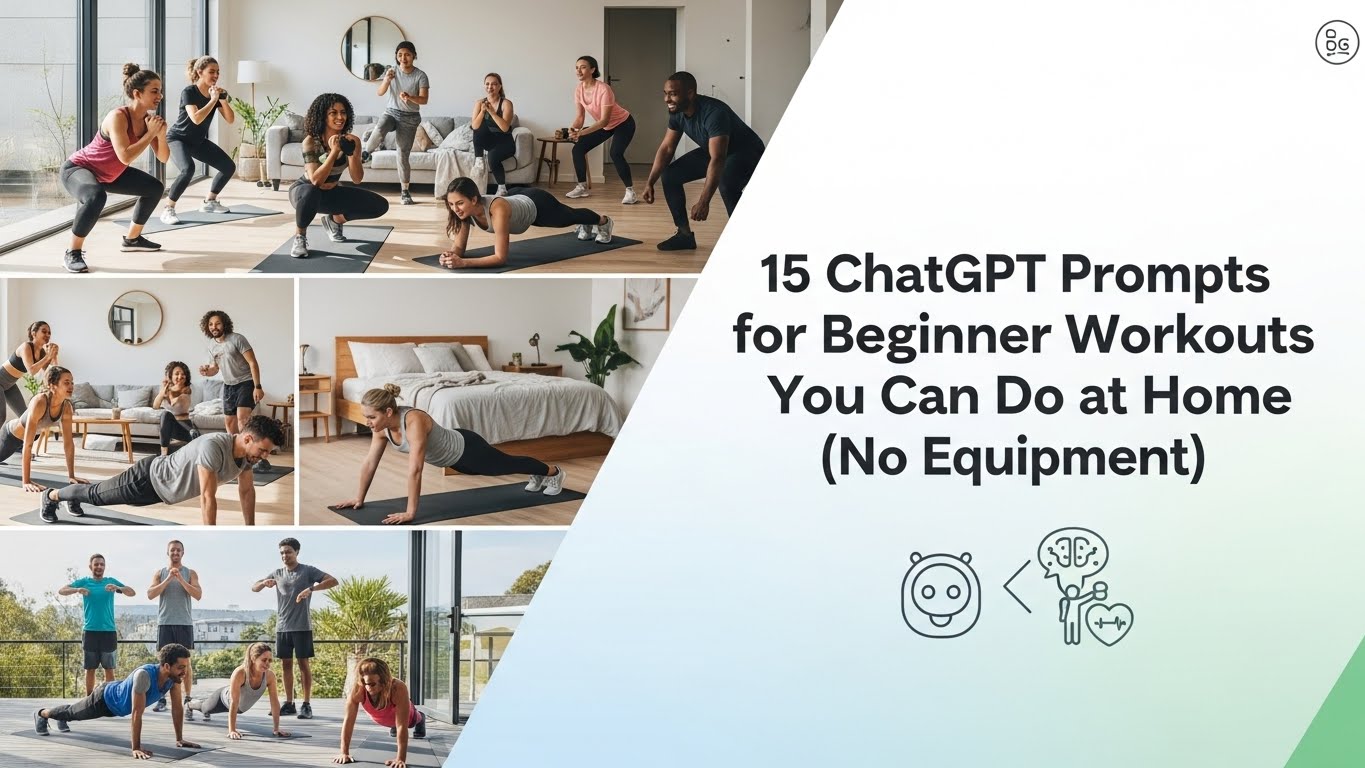
Here’s what nobody tells you: you don’t need a gym membership, expensive equipment, or even workout clothes. Your body is the only equipment you need, your living room is your gym, and you’re already qualified to start—right now, exactly as you are. The real challenge isn’t access to resources. It’s knowing what to do, how to do it safely, and how to progress without a personal trainer guiding you.
That’s where these 15 ChatGPT prompts come in. They’re designed to create personalized beginner workout routines that work with your current fitness level, your available space, your schedule, and your specific goals—all using just your bodyweight. No equipment, no excuses, no intimidation. Just effective workouts that meet you exactly where you are.
Why Home Bodyweight Workouts Actually Work Better for Beginners
Before we dive into the prompts, let’s destroy some myths about beginner fitness:
Bodyweight training builds functional strength. Unlike machines that isolate muscles, bodyweight exercises teach your body to move as a coordinated unit. This translates directly to real-life activities—carrying groceries, playing with kids, or preventing falls.
No equipment means perfect form focus. Without weight resistance to distract you, you can concentrate entirely on movement quality. This builds the foundation that prevents injuries when you eventually add resistance.
Home workouts eliminate intimidation. No one’s watching, judging, or waiting for equipment. You can make mistakes, take breaks, and move at your own pace without social pressure.
Progression happens naturally. As you get stronger, the same exercises become easier. ChatGPT can help you progress by adjusting tempo, adding repetitions, or introducing variations—all without buying anything.
Consistency beats intensity. A moderate workout done consistently at home beats sporadic intense gym sessions. Removing barriers to starting makes consistency achievable.
Your schedule dictates success. Home workouts fit into real life. Ten minutes before breakfast, twenty minutes during lunch, or five minutes before bed all count. Perfection isn’t required.
Now let’s explore how to use ChatGPT to create workouts tailored specifically to you.
How to Use These Prompts for Maximum Results
Getting the most from these prompts requires honest self-assessment and clear communication:
Be brutally honest about your fitness level. Overestimating leads to injury or burnout. Underestimating leaves you bored. Tell ChatGPT the truth about your current capabilities.
Specify your available space. “Small apartment” tells ChatGPT to avoid jumping or running. “Backyard” opens up more options. Physical limitations matter.
Mention any injuries or limitations. Bad knees? Lower back issues? Shoulder problems? ChatGPT can modify exercises to work around these constraints.
State your actual available time. If you realistically have 15 minutes, say so. A 45-minute workout you never do is useless.
Clarify your primary goal. Weight loss, strength building, general fitness, stress relief, or energy boost all require different approaches.
Request demonstration guidance. Ask for detailed form cues or links to demonstration videos for exercises you don’t know.
Let’s get to the prompts, organized by workout type and fitness goals.
Foundation Building Prompts
1. The Total Beginner’s First Workout
I'm a complete beginner who hasn't exercised regularly in [timeframe]. I want to start working out at home with zero equipment. Create a gentle introduction workout that takes [time available] and won't leave me so sore I can't move tomorrow. Include exercises that teach basic movement patterns, with detailed form instructions for someone who has never done these movements before. Explain what I should feel working and what indicates I'm doing something wrong. Make this achievable enough that I'll actually want to do it again.
Why this works: This prompt prioritizes sustainability over intensity. The focus on avoiding excessive soreness prevents the common beginner mistake of doing too much too soon and quitting from discouragement.
2. The Progressive 30-Day Launch Plan
Design a 30-day beginner bodyweight workout progression that starts extremely easy and gradually builds difficulty. I have [time available] per workout and can exercise [number] days per week. I want to see measurable progress each week without overwhelming myself. Include specific progression markers so I know when to move to the next level. Explain the reasoning behind the progression strategy so I understand why each week looks different.
Why this works: Structured progression prevents plateaus and provides motivation through visible improvement. The 30-day framework feels achievable while being long enough to build habits.
3. The Form-Focused Foundation Builder
I want to master the fundamental bodyweight exercises with perfect form before progressing to anything complex. Create a workout focused on [list 3-5 basic movements like squats, push-ups, planks] with detailed form breakdowns. Include common mistakes to avoid, what the correct movement should feel like, and progression/regression options based on my current strength. I'd rather do movements perfectly than do more advanced exercises poorly.
Why this works: This prompt prioritizes quality over quantity, building the foundation that prevents injuries and ensures long-term success. Form mastery is the true beginner priority.
Goal-Specific Workout Prompts
4. The Fat-Burning Metabolism Booster
Create a beginner-friendly bodyweight workout designed for fat loss and metabolism boosting. I'm [current fitness level] and have [time available]. I want something that keeps my heart rate elevated without being so intense I give up. Include modifications for exercises that feel too difficult and explain why this structure supports fat loss. Balance intensity with sustainability—I need to be able to do this consistently, not just once.
Why this works: Fat loss requires sustainable calorie burn, not extreme intensity. This prompt creates workouts that elevate heart rate while remaining achievable for beginners.
5. The Strength Builder for Real Life
I want to build functional strength for everyday activities—lifting, carrying, bending, reaching. Design a bodyweight workout that focuses on practical strength applicable to real life. I'm [fitness level] with [time available]. Include exercises that work multiple muscle groups together, not isolated movements. Explain how each exercise translates to daily activities so I understand the practical value.
Why this works: This prompt connects fitness to real-world benefits, increasing motivation. Functional training also prevents injury in daily life.
6. The Flexibility and Mobility Enhancer
I'm extremely stiff and inflexible, which affects my daily comfort and movement. Create a beginner bodyweight workout that emphasizes mobility and flexibility while still building some strength. I have [time available] and struggle with [specific tight areas: hips/shoulders/hamstrings]. Include dynamic stretching, mobility work, and exercises that improve range of motion. This should feel good during and after, not painful.
Why this works: Many beginners need mobility work before they can perform standard exercises safely. This prompt addresses the foundation of movement quality.
Time-Based Workout Prompts
7. The 10-Minute Morning Energizer
I want a quick bodyweight workout to do every morning before [work/breakfast/shower] that takes exactly 10 minutes including warm-up. The goal is to energize me for the day, not exhaust me. I'm [fitness level] and need something I can do in [available space: small bedroom/living room]. This should be simple enough to do half-asleep but effective enough to feel worthwhile. No jumping if possible—I have downstairs neighbors.
Why this works: Morning workouts need to be quick, quiet, and energizing. This prompt creates realistic routines that fit into real morning schedules without disrupting household logistics.
8. The Lunch Break Quick Session
Design a bodyweight workout I can do during my lunch break that takes [time available] including time to cool down and not get too sweaty. I work from home and want to break up sitting time with movement. The workout should re-energize me for afternoon work, not leave me exhausted. Include options that can be done in business casual clothing if needed. Focus on posture correction and energy boost.
Why this works: Midday workouts have specific constraints—time limits, sweat concerns, and energy management. This prompt addresses the unique requirements of exercise breaks during work.
9. The Evening Wind-Down Movement
Create a gentle evening bodyweight workout that helps me decompress from the day without being so intense I can't sleep afterward. I have [time available] before bed and want something that reduces stress, releases tension, and prepares my body for rest. I'm [fitness level] and tend to hold tension in [body areas]. This should feel restorative, not depleting.
Why this works: Evening workouts need different intensity than morning or midday sessions. This prompt creates movement that supports sleep rather than interfering with it.
Space and Situation Prompts
10. The Tiny Space Workout Solution
I live in a very small apartment with limited floor space. Create a bodyweight workout that requires minimal space—basically just room to stand and lie down. I have [time available] and am [fitness level]. Avoid exercises that need running room or space to move laterally. Get creative with vertical space and stationary movements. Include modifications that work in truly cramped conditions.
Why this works: Space constraints are real barriers for many people. This prompt ensures workouts fit actual living situations rather than ideal gym-sized spaces.
11. The Silent Apartment-Friendly Routine
I have neighbors above and below me, so I need a completely silent workout—no jumping, no dropping to the floor heavily, no loud movement. Create a [time length] bodyweight workout that's apartment-friendly and quiet but still effective. I'm [fitness level] and want to work on [goals]. Prove that effective workouts don't have to be loud or high-impact.
Why this works: High-impact exercises dominate many workout videos, but they’re impractical for apartment living. This prompt creates neighbor-friendly alternatives that still deliver results.
12. The Outdoor Bodyweight Session
I have access to outdoor space [backyard/park/patio] and want a bodyweight workout that takes advantage of being outside. Create a [time length] routine for [fitness level] that feels different from indoor workouts. Include exercises or variations that work better outdoors and explain how to adapt if weather changes plans. This should make me excited to exercise outside, not just tolerating it.
Why this works: Outdoor workouts offer mental health benefits beyond physical exercise. This prompt leverages environmental variety to boost motivation and enjoyment.
Special Focus and Recovery Prompts
13. The Lower Body No-Jump Blast
I want to work my legs, glutes, and lower body without any jumping or high-impact movements. I have [injury/limitation or preference for low-impact]. Create a bodyweight lower body workout that's challenging despite being low-impact. I'm [fitness level] with [time available]. Include variations that increase difficulty without adding impact. Make my legs burn without destroying my joints.
Why this works: Lower body training often defaults to jumping movements, but these aren’t suitable for everyone. This prompt creates effective alternatives that protect joints while building strength.
14. The Upper Body and Core Combination
Design a bodyweight workout focused on upper body and core strength. I'm [fitness level] and struggle with [specific challenge: push-ups/arm strength/core stability]. I have [time available] and want exercises that build functional upper body strength without equipment. Include progressions from easiest to hardest so I can start where I am and work up. Explain how to engage core properly throughout.
Why this works: Upper body bodyweight training requires understanding progression from modifications to full movements. This prompt creates a clear progression path.
15. The Active Recovery and Mobility Day
I worked out yesterday and am sore but want to move gently today. Create an active recovery bodyweight session that promotes blood flow, reduces soreness, and maintains momentum without overtaxing my recovering muscles. I'm [fitness level] and particularly sore in [body areas]. This should feel good and help recovery, not add to fatigue. Include gentle strengthening mixed with mobility work.
Why this works: Recovery is when fitness improvements actually happen, but complete rest feels demotivating. This prompt creates movement that supports recovery rather than hindering it.
Advanced Strategies for Home Workout Success
Beyond individual workouts, building a sustainable home fitness practice requires systematic thinking:
Creating Your Home Workout Environment
Designate a workout space. Even if it’s just a yoga mat’s worth of floor, having a “workout spot” creates mental association and removes decision fatigue.
Minimize setup time. The faster you can start, the more likely you’ll actually work out. Keep your space clear or have a 30-second setup routine.
Control distractions. Put phone on do-not-disturb, tell household members you need 20 minutes, or wake up before everyone else. Interruptions kill momentum.
Temperature matters. You’ll work harder in cooler environments. Open windows or use a fan to prevent overheating in small spaces.
Mirror or phone placement. Being able to see yourself helps with form. Prop your phone up to record yourself or use a mirror to check positioning.
Programming Your Week for Sustainable Progress
Start with 2-3 days per week. Beginners need recovery time. More isn’t better when you’re building the habit.
Alternate focus areas. Upper body one day, lower body the next, full body the third. This prevents overuse and allows muscle recovery.
Schedule like appointments. “I’ll work out when I have time” never works. Calendar it like you would a meeting.
Build streaks, not perfection. Missing one workout isn’t failure. The habit is what matters, not individual sessions.
Weekly variety prevents boredom. Rotate through different prompts to keep things fresh while maintaining consistency.
Tracking Progress Without Equipment
Repetition increases. If you could only do 5 push-ups last week and can do 8 this week, you’re progressing.
Form improvements. Deeper squats, fuller range of motion, better control—these indicate advancement even if reps stay the same.
Recovery speed. When workouts that once left you sore for days now only cause mild soreness, your fitness is improving.
Daily life ease. Stairs feel easier, you don’t huff and puff carrying groceries, playing with kids doesn’t exhaust you—this is real-world progress.
Energy levels. Increased daily energy is one of the first and most motivating improvements from consistent exercise.
Sleep quality. Regular exercise typically improves sleep, which further supports fitness improvements.
Understanding Bodyweight Exercise Progression
Leverage changes difficulty. Moving hands or feet closer together makes push-ups and squats harder. Elevating hands makes push-ups easier.
Tempo manipulation. Slowing down movements increases difficulty without changing the exercise. Try 3-second descents and 3-second ascents.
Pause variations. Adding pauses at the bottom of squats or planks dramatically increases challenge.
Range of motion. As you get stronger, increase how deep you squat or how low you descend in push-ups.
Unilateral work. Transitioning from two-leg squats to single-leg variations, or two-arm push-ups to one-arm progressions.
Combination movements. Linking exercises together (burpee = squat + plank + jump) increases complexity and intensity.
Common Beginner Mistakes and How to Avoid Them
Learning from others’ mistakes saves you time, frustration, and potential injury:
Mistake #1: Doing Too Much Too Soon
The problem: Enthusiasm leads to overtraining. You work out six days straight, get incredibly sore, burn out, and quit.
The solution: Start with just 2-3 workouts per week. Your body needs recovery time to adapt. Soreness that prevents movement is counterproductive.
What to tell ChatGPT: Explicitly request a schedule with built-in rest days and progressive volume increases.
Mistake #2: Ignoring Pain Signals
The problem: Confusing “good discomfort” (muscle burn) with “bad pain” (joint or sharp pain) leads to injury.
The solution: Muscle fatigue and burning is normal. Sharp pain, joint pain, or pain that worsens during exercise is a stop signal.
What to tell ChatGPT: Describe any pain you experience and ask for modifications or alternative exercises that avoid that movement pattern.
Mistake #3: Inconsistent Effort
The problem: Working out sporadically—crushing it one week, skipping the next two—prevents adaptation and progress.
The solution: Moderate, consistent effort beats sporadic intensity every time. Three mediocre workouts per week for a month beats one perfect workout.
What to tell ChatGPT: Request realistic workout durations and frequencies you can actually maintain, not aspirational schedules you’ll abandon.
Mistake #4: Neglecting Warm-Up and Cool-Down
The problem: Jumping straight into exercise without preparation increases injury risk. Skipping cool-down impairs recovery.
The solution: Five minutes of gentle movement before exercise and five minutes of stretching after makes a significant difference.
What to tell ChatGPT: Always request warm-up and cool-down instructions as part of your workout routine.
Mistake #5: Comparing Yourself to Others
The problem: Watching fit influencers or comparing yourself to friends creates unrealistic expectations and discouragement.
The solution: Your only competition is yesterday’s version of yourself. Progress is personal.
What to tell ChatGPT: Focus prompts on YOUR current abilities and goals, not generic “beginner” assumptions.
Nutrition Basics to Support Your Home Workouts
Exercise is only part of the fitness equation. While detailed nutrition advice requires individualization, these basics support beginner workout recovery:
Protein supports muscle repair. Aim for protein with most meals—eggs, Greek yogurt, chicken, fish, beans, lentils, tofu. Your recovering muscles need building blocks.
Hydration affects everything. Dehydration impairs performance and recovery. Drink water before, during, and after workouts.
Carbs fuel workouts. Don’t fear carbohydrates—they’re your body’s preferred exercise fuel. Complex carbs like oats, sweet potatoes, and whole grains support energy.
Post-workout timing matters somewhat. Eating within 1-2 hours after exercise optimizes recovery, but daily overall nutrition matters more than precise timing.
Sleep is when gains happen. Seven to nine hours of quality sleep is when your body actually adapts to exercise stress and builds fitness.
Motivational Strategies for Home Workout Consistency
Motivation fluctuates, but systems create consistency:
Building the Exercise Identity
Shift from “I should work out” to “I’m someone who works out.” Identity drives behavior more than willpower.
Start absurdly small. If necessary, begin with just 5 minutes. Consistency builds the identity; duration can increase later.
Celebrate systems, not just outcomes. “I worked out three times this week” is worth celebrating regardless of weight or appearance changes.
Connect to deeper values. Exercise isn’t just about looking good—it’s about having energy for your kids, maintaining independence as you age, or managing stress.
Making It Enjoyable
Music matters. Create workout playlists that energize you. Music can increase perceived energy and enjoyment significantly.
Variety prevents boredom. Rotate through different ChatGPT prompts to try new workout styles and formats.
Track victories. Keep a simple log of completed workouts. Seeing your consistency streak motivates continuation.
Reward consistency. After completing your first week, month, or 90 days of consistent exercise, treat yourself to something meaningful.
Handling Inevitable Setbacks
Illness or injury aren’t moral failures. Rest when sick, modify around injuries, and resume when ready.
Travel disrupts routines. Pack bodyweight workout prompts for hotel rooms. Even 10 minutes maintains momentum.
Busy periods happen. When life gets chaotic, doing something—even 5 minutes—beats skipping completely.
Lost motivation returns. Motivation naturally waxes and wanes. Keep showing up even when feeling unmotivated; the feeling follows action.
Your Fitness Journey Starts Right Now
You now have 15 powerful ChatGPT prompts specifically designed to create beginner bodyweight workouts that work for your real life—your fitness level, your space, your schedule, your goals. These prompts remove the guesswork, the intimidation, and the barriers that keep people from starting.
The fitness industry wants you to believe you need expensive gyms, complicated equipment, and expert trainers. That’s convenient for their business model but completely unnecessary for your success. Your body, your floor space, and your commitment are sufficient.
Here’s what starting looks like, right now: Stand up. Choose one prompt from this list that matches your current situation. Open ChatGPT. Paste the prompt and customize it with your honest details—your true fitness level, your real available time, your actual goals.
Then read the workout ChatGPT creates. Don’t just bookmark it for “someday.” Clear a small space, set a timer, and do the workout right now. Not tomorrow. Not Monday. Not January 1st. Now.
It won’t be perfect. You might not finish it. You might struggle with exercises you thought would be easy. That’s completely fine. Starting imperfectly beats waiting for perfect conditions that never arrive.
The version of yourself six months from now—stronger, more energetic, more confident—is built one workout at a time, starting with the one you do today.
Your living room is waiting. Your first workout is one prompt away. Stop planning. Start moving.