
Let’s talk about the elephant in the room—or more accurately, the empty wallet after grocery shopping. You walk into the store planning to spend $100, somehow leave with $250 worth of groceries, and still end up ordering takeout three nights that week because you “don’t have anything to eat.” Meanwhile, vegetables rot in the crisper drawer, that expensive specialty ingredient sits untouched, and you’re Googling “how to afford food” at 2 AM.
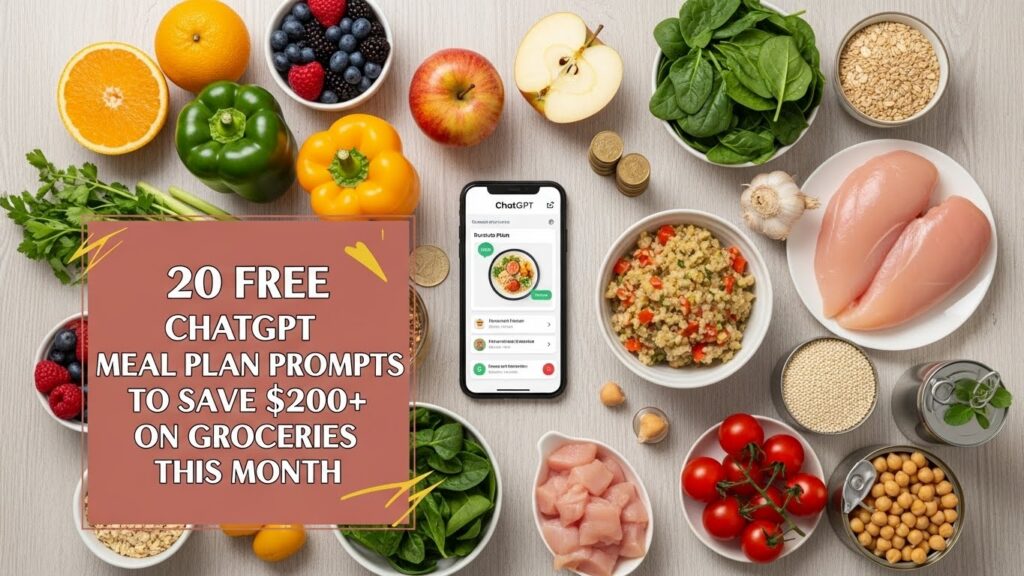
Here’s the uncomfortable truth: most people aren’t overspending on groceries because they’re buying luxury items. They’re hemorrhaging money through poor planning, impulse purchases, food waste, and the takeout fallback that happens when meal planning fails. The average American family wastes $1,500 annually on unused food—that’s $125 per month literally thrown in the garbage.
But what if you could cut your grocery bill by $200+ this month while actually eating better, wasting less, and never standing in front of the fridge wondering what’s for dinner? That’s exactly what these 20 ChatGPT meal planning prompts will help you achieve. No extreme couponing, no eating ramen for every meal, no deprivation—just strategic planning that respects both your budget and your taste buds.
Why Most Meal Planning Fails (And Costs You Money)
Before we dive into the prompts, let’s understand why traditional meal planning often makes grocery bills worse, not better:
Generic plans ignore your reality. Pinterest meal plans look gorgeous but require ingredients you’ll use once and never touch again. That $8 bottle of fish sauce for one recipe? Pure waste when you don’t cook Asian food regularly.
Overambitious planning leads to waste. You plan seven elaborate dinners, life gets busy, you cook three, and the rest of those ingredients spoil. Ambition without realism equals expensive compost.
No strategy for using what you have. Most people plan meals without checking their pantry, fridge, or freezer first. You buy more pasta when you have five boxes already. You purchase vegetables you already own that are slowly dying.
Portion misjudgment multiplies costs. Recipes serving four are useless for a household of two unless you plan for leftovers. Cooking too much breeds waste; cooking too little triggers takeout.
Ignoring sale cycles wastes opportunities. Proteins go on rotation sales, seasonal produce costs less, but without a system to capitalize on these patterns, you overpay consistently.
No flexibility means expensive pivots. When Thursday’s planned salmon dish doesn’t sound appealing, you abandon the plan entirely and order pizza, wasting both the unused salmon and the $40 on delivery.
ChatGPT solves all these problems by creating hyper-personalized meal plans that work with your actual life, budget, and food preferences.
How to Use These Prompts to Actually Save Money
Getting real savings from these prompts requires strategic implementation:
Start with honest numbers. Tell ChatGPT your actual current spending and your target budget. Be specific: “I currently spend $800/month for a family of four and want to reduce to $600.”
List what you already own. Before planning, inventory your pantry, fridge, and freezer. Include everything, even those random cans you forgot about. ChatGPT can build meals around existing inventory.
Specify your household details. Number of people, ages, dietary restrictions, and preferences all impact meal planning effectiveness. A plan for two adults differs dramatically from one for a family with picky toddlers.
Be honest about your cooking reality. If you only have 20 minutes on weeknights, don’t request elaborate recipes requiring 90 minutes. Realistic plans get followed; aspirational plans get abandoned.
Track your first month. Save receipts and monitor actual spending to see where savings come from. This data helps refine future prompts for even better results.
Now let’s explore the prompts, organized by savings strategy and household situation.
Foundation Budget Planning Prompts
1. The Complete Monthly Meal Plan Overhaul
I want to completely overhaul my grocery spending. I currently spend $[current amount] per month feeding [number of people]. My target is $[goal amount]. Create a full month meal plan (breakfast, lunch, dinner, snacks) that hits this budget while ensuring nutritious, satisfying meals. Consider [dietary restrictions/preferences]. Include a master grocery list organized by week and shopping tips to stay on budget. Explain where the biggest savings come from and how to maintain this long-term.
Why this works: This comprehensive prompt addresses the entire food budget ecosystem, not just dinners. Seeing the complete picture reveals where money disappears and creates accountability.
2. The Weekly Budget Meal Framework
Design a flexible weekly meal planning framework for a budget of $[amount] per week for [household size]. I want a template I can reuse where I swap specific ingredients based on sales and seasons. Include the optimal number of proteins, grains, vegetables, and other staples to buy weekly. Explain the strategy behind ingredient overlap so multiple meals share components without repetition fatigue. Make this sustainable, not deprivation-based.
Why this works: Templates provide structure while allowing flexibility. This approach works with your life instead of requiring you to follow rigid plans that inevitably fail.
3. The Pantry Inventory Integration Plan
I want to use what I already have before buying more. Here's my current pantry inventory: [list items]. Here's what's in my fridge: [list items]. Freezer contents: [list items]. Create a week of meals using primarily these ingredients, with a minimal supplemental shopping list for fresh items only. Calculate how much I'll save by eating down my inventory. Make the meals actually appetizing, not just "using stuff up."
Why this works: Most households have $200-300 worth of food sitting unused. This prompt transforms inventory into meals, providing immediate savings without any shopping.
Protein Strategy Prompts
4. The Versatile Protein Bulk Buy Plan
I want to buy [protein: chicken/ground beef/pork/tofu/beans] in bulk when on sale and create multiple different meals from it without boredom. Design a meal plan showing 5-7 distinct meals using [quantity] of this protein. Each meal should taste completely different—different cuisines, preparations, and flavor profiles. Include proper storage and food safety information. Calculate the per-meal protein cost and show the savings versus buying smaller quantities or pre-seasoned options.
Why this works: Bulk buying saves money only if you actually use everything. This prompt prevents “chicken every night” fatigue that leads to food waste and takeout.
5. The Plant-Based Protein Savings Switch
I want to reduce meat consumption to save money without my family feeling deprived. Create a meal plan that substitutes expensive proteins with affordable plant-based alternatives for [number] meals per week. For [household size] with budget of $[amount]. Make these meals satisfying and flavorful enough that we don't miss meat. Include a cost comparison showing savings per meal versus meat-based versions. Ease us into this gradually—don't assume we're ready for all vegetables all the time.
Why this works: Meat is often the most expensive grocery category. Strategic reduction—not elimination—creates significant savings while maintaining satisfaction.
6. The Budget Protein Rotation System
Design a monthly protein rotation that takes advantage of typical supermarket sale cycles. For [location/store if known], create a schedule: Week 1 focuses on [protein on sale], Week 2 on [different protein], etc. Build meals around these rotating proteins with complementary budget-friendly sides. Include timing advice for buying and freezing proteins when they hit their sale cycles. Show the annual savings versus buying proteins at random times.
Why this works: Proteins follow predictable sale patterns. Planning around these cycles can cut protein costs by 40-60% without changing what you eat.
Strategic Shopping Prompts
7. The Loss-Leader Strategy Meal Plan
My local grocery stores are [list stores]. Each week they have loss-leader sales to get customers in the door—proteins for $1.99/lb, produce at 50% off, etc. Create a meal planning system that builds weekly menus around these loss leaders. Teach me to scan weekly ads and quickly construct meal plans that maximize these deals. Include strategies for stocking up when prices are lowest. Make this time-efficient—I can't spend hours planning.
Why this works: Loss-leader pricing is aggressive—stores lose money on these items to drive foot traffic. Shopping strategically around these sales creates outsized savings.
8. The Seasonal Produce Maximization Plan
Create monthly meal plans that emphasize seasonal produce when it's cheapest and tastes best. I'm in [region/climate zone]. For the current month, identify which produce is in season and design meals that showcase these ingredients. Include preservation tips (freezing, canning, etc.) for buying extra when prices bottom out. Show the cost difference between seasonal versus out-of-season produce and explain why this matters beyond just price.
Why this works: Seasonal produce can cost 50-75% less than out-of-season. Plus, it tastes better, encouraging actual consumption instead of waste.
9. The Store Brand Swap Savings Plan
I'm loyal to name brands out of habit. Analyze my typical grocery list: [list items] and identify which items have quality store-brand alternatives versus which are worth the name-brand premium. Create meal plans that explicitly use store brands where they're equivalent. Calculate monthly savings from strategic store-brand swapping. Include taste-test recommendations so I'm not blindly switching everything.
Why this works: Store brands can save 20-40% on identical products, but not all store brands are equal. This prompt identifies where swapping makes sense.
Food Waste Prevention Prompts
10. The Zero-Waste Weekly Meal Plan
I'm tired of throwing away food. Design a meal plan where every ingredient gets used completely—no half-used produce rotting, no partial cans forgotten, no lonely tablespoons of sauce wasted. For [household size] with budget $[amount]. Show how ingredients flow through the week: Monday's roasted vegetable excess becomes Tuesday's soup, Wednesday's leftover grains become Friday's fried rice, etc. Make waste prevention the primary organizing principle.
Why this works: Food waste is money waste. This prompt treats ingredients as valuable resources that deserve complete utilization, potentially saving $100+ monthly.
11. The Leftover Transformation System
Create a meal plan designed for intentional leftovers that become completely different meals—not just reheated versions. For [household size], design dinners where planned leftovers transform into next-day lunches or future dinners. Example: Monday's roast chicken becomes Tuesday's chicken tacos AND Wednesday's chicken soup. Include storage tips and food safety guidelines. Make leftovers exciting, not boring.
Why this works: Planned leftovers eliminate both food waste and the need to buy lunch daily. The transformation approach prevents flavor fatigue.
12. The Freezer Meal Prep Investment Plan
I want to invest one weekend making freezer meals that save money and time over the next month. With a budget of $[amount], design a batch cooking day producing [number] freezer-ready meals. Include shopping list, prep schedule, storage instructions, and reheating guidance. Calculate the per-meal cost versus takeout or convenience foods. Make these meals family-friendly and genuinely tasty when reheated, not just edible.
Why this works: Batch cooking multiplies efficiency. One cooking session prevents multiple expensive takeout nights, creating exponential savings.
Dietary Restriction and Preference Prompts
13. The Allergy-Friendly Budget Plan
I/we have food allergies to [list allergens] which make groceries expensive since specialty products cost more. Create a budget meal plan for $[amount] per week that's safe for our needs without relying on expensive specialty products. For [household size]. Focus on naturally allergen-free whole foods rather than processed substitutes. Make this affordable AND delicious—allergies shouldn't mean either breaking the bank or eating boring food.
Why this works: Allergy-friendly specialty products are marked up 200-400%. This prompt focuses on naturally safe foods, cutting costs while maintaining nutrition and flavor.
14. The Kid-Friendly Budget Battle Plan
I have picky eaters aged [ages] who reject most meals, leading to expensive backup options and food waste. Create a budget-friendly meal plan with kid-approved options that adults enjoy too. Budget: $[amount] for [household size]. Include strategies for introducing new foods without battle, backup options that don't blow the budget, and ways to involve kids in meal planning for buy-in. Make family dinners peaceful AND affordable.
Why this works: Picky eaters drive expensive habits—special meals, rejected food, constant snacks. This prompt creates peace and savings simultaneously.
15. The Special Diet Budget Optimization
I'm following [diet: keto/paleo/vegetarian/vegan/Mediterranean] which feels expensive. Create a budget meal plan for $[amount] per [week/month] for [household size] that adheres to this diet without premium-priced specialty foods. Focus on affordable whole foods that naturally fit the diet. Show me the cost difference between expensive "diet products" versus real food that happens to align with my needs. Make this sustainable long-term.
Why this works: Diet specialty products are expensive marketing. This prompt reveals how to follow dietary patterns using regular, affordable ingredients.
Time-Saving and Convenience Prompts
16. The 30-Minute Budget Weeknight Plan
I have no time on weeknights but still want to save money versus takeout. Create a week of meals for [household size] that each take 30 minutes or less, total cost $[amount]. Include minimal-prep options for exhausted evenings. Calculate savings versus our typical takeout spending of $[amount]. Make these genuinely quick and easy, not "30 minutes" that actually takes an hour. I need real solutions for real busy nights.
Why this works: Time pressure is the #1 reason people abandon meal plans for expensive takeout. This prompt creates realistic alternatives that compete with delivery convenience.
17. The Instant Pot/Slow Cooker Budget Strategy
I have an [Instant Pot/slow cooker/both]. Design budget meals that maximize this equipment for hands-off cooking. For [household size] with budget $[amount]. Include dump-and-go options for crazy mornings, make-ahead prep instructions, and meals that cook while I'm at work. Show how these tools enable cheaper cuts of meat and bulk dried beans to become delicious meals. Make my appliance earn its counter space.
Why this works: These appliances tenderize cheap ingredients and require minimal active cooking time, creating both time and money savings.
Single Person and Small Household Prompts
18. The Single-Person No-Waste Plan
I'm cooking for one and struggle with recipes designed for families—everything spoils before I can eat it. Create a budget meal plan for $[amount per week] that minimizes waste for a single person. Include strategies for buying in appropriate quantities, using ingredients across multiple meals, and freezing in single portions. Address the loneliness of always eating alone by making meals I'm excited about. Don't assume I want to eat the same meal five days straight.
Why this works: Single-person households face unique challenges—bulk pricing doesn’t help if food spoils, and recipe scaling is tricky. This prompt addresses these specific issues.
19. The Couple’s Shared Cooking Budget
We're a couple with different food preferences: Partner A likes [preferences], Partner B likes [preferences]. Budget is $[amount] per week. Create a meal plan that satisfies both without cooking completely separate meals. Include strategies for shared base components with customizable elements. Show how cooking together saves money versus separate meals or constant dining out. Make meal planning strengthen our relationship, not create conflict.
Why this works: Different preferences often lead to expensive duplicate cooking or constant restaurant compromises. This prompt finds middle ground that saves money and reduces stress.
Advanced Optimization Prompts
20. The Total Food Budget Audit and Overhaul
I want to understand exactly where my food money goes and fix it. Current spending: $[amount] on groceries, $[amount] on takeout/dining, $[amount] on coffee/snacks, $[amount] on work lunches. For [household size]. Create a comprehensive strategy addressing all categories, with meal planning that eliminates expensive patterns. Set realistic targets for each category. Include meal prep for work lunches, breakfast routines that prevent expensive coffee runs, and snack strategies. Give me a complete food budget transformation with measurable goals.
Why this works: Total budget optimization addresses all spending, not just grocery bills. Coffee runs, work lunches, and convenience purchases often exceed grocery spending.
Implementation Strategies for Maximum Savings
Having prompts isn’t enough—you need execution strategies:
Week One: Assessment and Planning
Track current spending ruthlessly. For one week, save every food-related receipt—groceries, takeout, coffee, snacks, everything. The total will probably horrify you. Good. That’s motivation.
Inventory everything you own. Open every cupboard, drawer, fridge shelf, and freezer corner. List it all. You likely have $200+ worth of unused food.
Choose your first prompt. Based on your biggest pain point—waste, time, pickiness, whatever—select one prompt to start with.
Customize and generate. Fill in your specific details honestly. Don’t fudge numbers or circumstances.
Week Two: First Implementation
Shop with your list only. No impulse buys, no “just in case” items. Stick to the ChatGPT-generated list ruthlessly.
Prep what you can. Wash vegetables, portion proteins, prep sauces. Reduce friction for future cooking.
Follow the plan, but track deviations. Note when and why you deviate from the plan. This data refines future planning.
Calculate week one savings. Compare this week’s spending to your average. Even small wins build momentum.
Week Three: Refinement
Adjust based on Week Two data. Tell ChatGPT what worked and what didn’t. Request modifications for better fit.
Add a second strategy. If you started with meal planning, add a leftover transformation prompt. Layer strategies for compounding savings.
Start building your recipe database. Save meals your household loved. These become rotation staples.
Week Four: Systematization
Create your template. You’ve now tested what works. Build a reusable framework for ongoing planning.
Automate what you can. Set recurring shopping days, prep times, and planning sessions. Systems beat motivation.
Measure total month savings. Calculate actual savings versus baseline. This number motivates continued effort.
Common Budget Meal Planning Mistakes to Avoid
Learning from others’ failures accelerates your success:
Mistake #1: Unrealistic Deprivation
The problem: Cutting your budget so aggressively that you feel deprived leads to rebellion binge spending that erases all savings.
The solution: Aim for 20-30% reduction initially, not 50%. Sustainable progress beats dramatic failure.
What to tell ChatGPT: Request meal plans that feel satisfying and include occasional treats within budget.
Mistake #2: Ignoring Household Buy-In
The problem: Creating a meal plan only you like guarantees family revolt and expensive backup meals.
The solution: Include everyone’s preferences in your prompt. Get family input before finalizing plans.
What to tell ChatGPT: List each household member’s favorite foods and dietary constraints.
Mistake #3: No Flexibility Buffer
The problem: Plans with zero flexibility collapse when life happens—unexpected late nights at work, sick kids, or just not feeling like the planned meal.
The solution: Build flexibility into your plan with backup options and acceptable deviation strategies.
What to tell ChatGPT: Request contingency plans for when the original plan doesn’t work.
Mistake #4: Buying in Bulk Without a Plan
The problem: That giant package of chicken seems economical until half rots in your freezer because you had no plan to use it.
The solution: Only bulk buy when you have specific meal plans for using everything before it spoils.
What to tell ChatGPT: Request bulk purchase plans that detail every meal using the bulk item.
Mistake #5: Treating All Savings Equally
The problem: Spending an hour couponing to save $3 while ignoring the $50/week you spend on work lunches.
The solution: Focus on high-impact savings first. The 80/20 rule applies—20% of changes create 80% of savings.
What to tell ChatGPT: Ask for an analysis of your spending to identify the highest-impact changes.
Beyond Meal Planning: Total Food Budget Optimization
Real savings require addressing the entire food spending ecosystem:
The Lunch Money Leak
The problem: $10-15 daily for work lunches = $200-300 monthly.
The solution: Dinner leftovers as planned lunches cuts this to near zero. Pack it the night before.
Implementation: Every dinner prompt should include “makes enough for tomorrow’s lunch” as a requirement.
The Coffee Shop Addiction
The problem: $5 daily fancy coffee = $100-150 monthly.
The solution: Home coffee setup costs $20-30 monthly versus $100-150 out.
Implementation: Invest in decent home coffee gear. Make it a pleasant morning ritual, not a sacrifice.
The Convenience Tax
The problem: Pre-cut vegetables, pre-marinated meats, meal kits—convenience adds 100-300% markup.
The solution: Do your own prep. Spend Sunday prepping for the week.
Implementation: Ask ChatGPT for efficient meal prep workflows that minimize waste and maximize convenience.
The Takeout Trap
The problem: “I’m too tired to cook” leads to $40+ delivery orders multiple times weekly.
The solution: Ultra-simple backup meals for exhausted nights. Think 15-minute options.
Implementation: Always have emergency meal components ready—pasta, jarred sauce, frozen vegetables.
Your $200+ Savings Start Tonight
You now have 20 powerful ChatGPT prompts specifically engineered to slash your grocery spending while improving your diet, reducing waste, and eliminating meal planning stress. These aren’t theoretical savings—they’re real money that stays in your bank account instead of going to grocery stores and restaurants.
The difference between people who successfully reduce food spending and those who remain trapped in expensive cycles comes down to one thing: having a system that works with real life, not against it. These prompts create that system, personalized to your exact situation.
Here’s your action plan starting right now: Open your banking app or credit card statement. Calculate exactly what you spent on food last month—groceries, takeout, restaurants, coffee, everything. Write that number down. Feel the weight of it.
Now choose one prompt from this list that addresses your biggest spending leak. For most people, that’s either food waste, lack of planning, or takeout fallback.
Open ChatGPT right now. Paste your chosen prompt. Fill in your real numbers—your actual household size, your honest budget, your true cooking ability, your genuine time availability.
Then implement that plan this week. One week. Track your spending. Compare it to your baseline.
When you see real money staying in your account—and you will if you follow through—you’ll have the motivation to continue. That first week of savings proves this works. The second week builds the habit. By week four, you’ll wonder how you ever spent so much on food.
Your grocery budget is bleeding money. These prompts are the tourniquet. Stop the bleeding tonight.
Your $200 monthly savings start with one prompt and one shopping trip. What are you waiting for?